Containerized Waste to Energy: What Fits in the Box
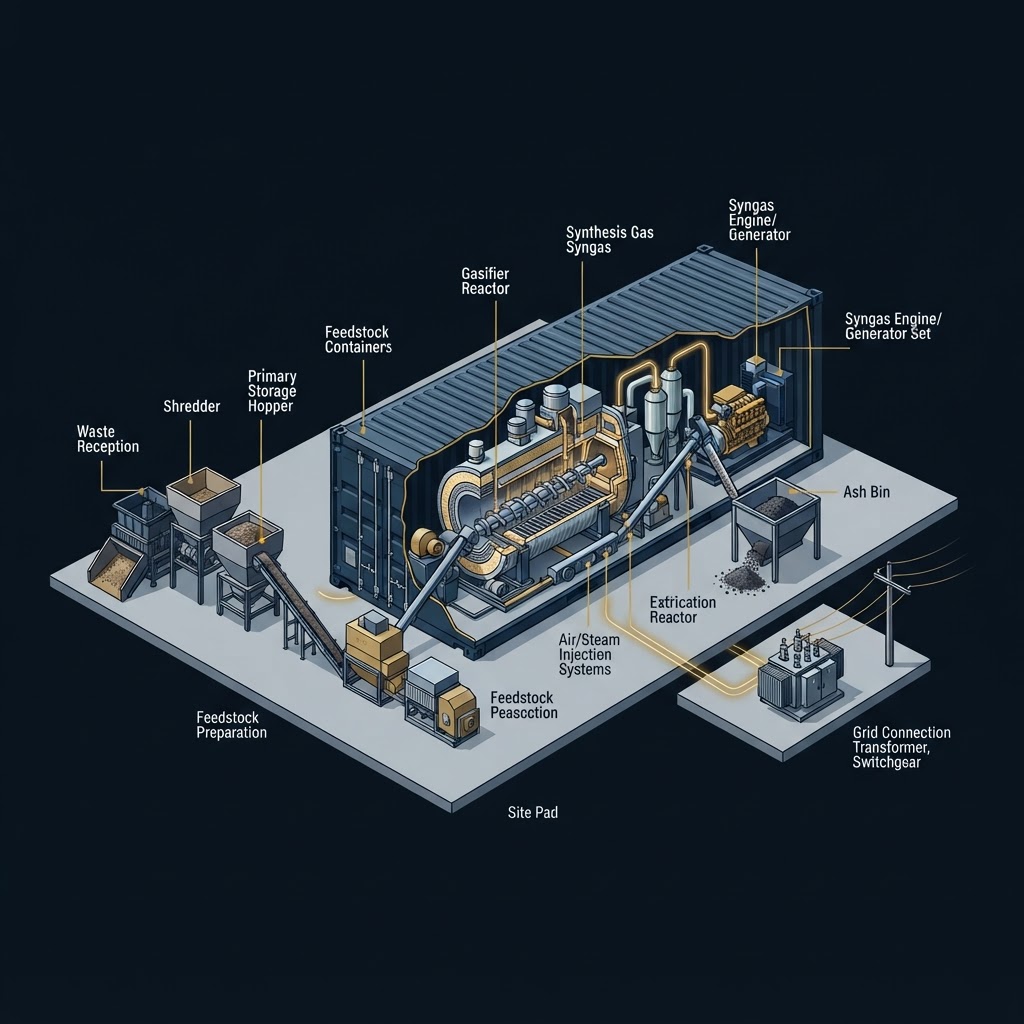
Search for containerized waste to energy and you get the same picture a dozen times: a shipping container on a gravel pad, a kg/h figure, and the word plug-and-play. It is a good picture. We build one ourselves, the X-150, a 150 kg/h fixed-bed downdraft gasifier that ships as a containerized unit (Zero-X).
What the picture leaves out is everything around the container. The reactor fits in the box. The waste preparation, the ash, the permits and the people mostly do not. And the best evidence on this is not in any brochure: it sits in field reports from a decade of US military and EPA programs that paid to put waste-to-energy units in containers and then published what happened.
This is the buyer's map those reports add up to.
What containerized waste to energy actually means
A containerized waste-to-energy unit is a waste conversion system built into, or skid-mounted onto, standard ISO shipping containers, so it ships by road or sea, installs on a prepared pad and can be moved again. The technology inside varies: combustion, gasification, pyrolysis, even plasma.
So does the size. Under one label you will find a spread of roughly a hundred to one:
| Unit | Format | Throughput | Main output |
|---|---|---|---|
| Terragon MAGS | Compact skid | 17 to 50 kg/h, by waste type | Heat, about 100 kWh per hour |
| Zero-X X-150 | Container | 150 kg/h | Syngas, hydrogen, biochar |
| ALL Power Labs Chartainer | 20 ft | 250 kg/h | 500 kWth heat plus biochar |
| eppm C-TWO | 20 ft per primary cell | 7 t/day per cell | Syngas to heat and power |
| Biogreen CM600 | 40 ft | Up to 1,800 kg/h | Up to 450 kW heat |
Sources: Terragon, ALL Power Labs, eppm C-TWO, Biogreen.
Two things to notice. First, "containerized" and "modular" are not the same class: the modular combustion systems in the US fleet run from 5 to 120 tonnes per day (NREL), far above most container units. Second, the output column matters as much as the throughput. The Chartainer FAQ states plainly that it has no electrical output at all; the power-producing sister unit converts far less of the feed into biochar. Compare a heat machine with a power machine on price per kg/h and you are comparing two different products.
If you are still deciding between technology families rather than formats, small scale waste to energy systems covers that decision and the hours-based economics behind it.
What fits in the container
The part that genuinely fits is the conversion core: feed lock, reactor, the immediate gas path, cooling and the control system.
A good published example is the IST Energy GEM, a mobile downdraft gasifier described as about the size of a large dumpster. Its spec sheet is unusually complete: 3 tonnes per day, 72 kWe net electrical output in CHP mode, dry filter gas cleaning and tar below 250 ppm after cleaning (Ellyin, Columbia University).
Read the same table one line further and the boundary of the box appears. Allowable moisture: 5 to 40%. Nominal feed: pellets of about half an inch. The machine fits in the container. The thing that turns your waste into half-inch pellets at under 40% moisture is a separate question.
Gas cleaning sits right on that boundary. In some designs it is inside the box, in others it is a second skid, and it decides whether the gas can feed an engine at all. That subject is big enough for its own article on removing tar from syngas.
What does not fit in the container
Feedstock preparation
NREL's 2023 comparison is blunt about gasification: inerts such as metal and glass must be sorted out, and shredding, drying and sizing of the feedstock may also be required to suit the gasifier. It rates the pathway as high complexity, with energy output highly sensitive to feedstock composition.
The military programs confirm it in hardware. The Battalion-Scale Waste-to-Energy Conversion system (BWEC), a containerized unit handling 2 to 4 tonnes a day of commingled waste for a net 60 kW, does not gasify waste as received. It first conditions unsorted waste into stable fuel pellets, then gasifies the pellets (ESTCP). The pellet line is part of the system, and it is part of the footprint, the power draw and the maintenance list.
Moisture and drying
Wet waste is where small units struggle. The US Army rotary kiln program, designed to fit in two 20 ft containers, used a 35 ton hydraulic ram to squeeze wet waste below 50% moisture before it entered the gasifier, and the prototype processed up to 1.25 tonnes a day of wet waste (US Army ERDC). That is an engineered answer to moisture. Most container brochures do not mention moisture at all.
Ash, char and the things that are not waste
Every tonne in leaves something behind, and removing it while the reactor runs is a hard mechanical problem at high temperature. The EPA's transportable gasifier for on-farm animal mortalities shows how hard. In its 2015 test the ash auger warped from the heat, its bearings failed and it seized; drag chains rated to about 750 C were running at almost double that (US EPA). The same report notes that some transportability was sacrificed to reduce cost, and that a pre-breaker, a finer and a 3,500 lb accumulator bin had to be added in front of the unit. Each of those is equipment outside the original box.
Emissions control and permits
A container does not change what the regulator sees: a waste treatment facility. The PyroGenesis transportable plasma unit at the US Air Force base at Hurlburt Field, 10.5 tonnes a day and skid-mounted on standard ISO containers, needed three separate permits (solid waste handling, air emissions and wastewater). Permitting alone took 10 months, and the whole turnkey project, including a building on a greenfield site, took 26 months to first electricity (PyroGenesis).
Emissions are not automatically solved either. BWEC passed every emissions metric except NOx.
Footprint, cranes and the site
The container is the smallest part of the land you need. The C-TWO example plant needs about 170 m2 for the containers plus about 36 m2 for the turbine room, and that figure explicitly excludes storage and the external manoeuvring area. FrontlineWaste's system ships as three containers, two 40 ft open tops and a 20 ft for ancillary equipment, with a 15 tonne power module, and needs either a double-drop trailer or a crane at the destination (FrontlineWaste).
Add a covered waste reception area, a dry store for prepared feed, an ash bin, a grid or load connection and a place for the operator to stand, and "plug-and-play" becomes a small site project.
Rated throughput is not delivered throughput
The field reports agree on one more pattern, and it matters more than any spec.
- PyroGenesis, first month: up to 320 kg/h against a nominal 437.5 kg/h.
- EPA transportable gasifier: earlier tests reached roughly one third of the intended design throughput.
- BWEC: met most performance objectives, with gaps in total waste reduction, maintenance and ease of use, and system economics.
- The rotary unit at Camp Buckner, West Point: six months of waste-to-electricity conversion was demonstrated but needs more testing because of the variable content of the waste, and emissions compliance was not fully demonstrated as planned (ESTCP).
- The Army rotary kiln: a 60 kW generator ran 244 hours on syngas from six waste mixes, cutting diesel use by 50 to 65% in most tests and 81% at best.
None of these programs failed in the sense of a fraud or a dead end. They are honest engineering reports, and they show the gap between a nameplate and a site. They also show that "it runs" is usually measured in hundreds of hours.
That is the number to ask for. Ours is 1,939 hours of continuous operation in Paris under the COMETHA project, processing 16,382 kg of digestate pellets, with 33% hydrogen in the syngas and 99.98% tar conversion (Zero-X on LinkedIn). Digestate is a real waste stream, not clean wood, and that is the point: a continuous-hours figure on a named, difficult feedstock is the only performance claim that survives contact with a site. The X-150 has also been validated at Verkoso with Fraunhofer IKTS and at Hochschule Zittau/Goerlitz on high-ash sludge, municipal waste and digestate.
Where a container makes commercial sense
The container earns its premium where waste is small in volume, far from a treatment plant and expensive to move: ships, military bases, islands, remote resorts, farms and processing sites. That is why the reference deployments cluster where they do. Terragon's units run on ships, military sites and Arctic communities.
The business case is set by what you stop paying for. A hotel in Bali pays 338K USD a year to truck its waste away, and island resorts run diesel at 0.40 USD/kWh. Against those two lines, a unit that turns the waste into on-site energy pays for very different reasons than one competing with cheap grid power. The detailed site economics are in waste to energy for hotels and resorts and, for sites without a reliable grid, off-grid power from waste.
Capital cost is the other lever. In Zero-X target markets, governments fund 56 to 70% of project CAPEX, which changes the arithmetic more than any efficiency gain.
Where the waste stream outgrows one box, the question shifts from containers to a small scale gasification plant with several reactors and shared preparation.
Questions to ask before you buy a container
Each maps to a documented failure above.
- What is the longest continuous run, and on what feedstock? One unbroken number with the waste named, not an annual availability claim.
- What feed specification does the reactor need? Moisture range, particle size, pellets or loose, inerts removed or not.
- Who supplies the preparation line, and is it in the price? Shredder, dryer, dewatering, pelletizer, sorting.
- What sits outside the container, and how much land does the whole site need? Include storage, reception, ash and manoeuvring.
- Is ash and char removed continuously while running? If it needs a shutdown, it caps your hours.
- What emissions data exists from a third-party test, and which permits will you need? Air, solid waste and wastewater are three separate applications.
- What throughput was delivered on real waste, against the nameplate?
- Does it make electricity, or only heat? Price per kg/h means nothing until outputs match.
A container is a good way to deliver a reactor. It is not a way to skip the site.
FAQ
How much waste can a containerized waste to energy unit process? Published units span roughly 17 kg/h at the small end to 1,800 kg/h for a 40 ft pyrolysis module, with most between about 150 kg/h and a few tonnes per day. Real throughput depends on the waste: Terragon rates the same unit at 17 to 50 kg/h depending on composition.
Do containerized waste to energy units need an environmental permit? In practice, yes. Regulators treat them as waste treatment facilities. The transportable unit at Hurlburt Field needed solid waste, air and wastewater permits, and the process took 10 months.
Can a containerized unit run on unsorted household waste? Some are designed to accept it, but the conversion step usually needs it prepared first. BWEC turned unsorted waste into pellets before gasifying, and NREL notes gasification generally requires inerts removed and may need shredding, drying and sizing.
Does every containerized waste to energy unit produce electricity? No. Some are heat and biochar machines with no electrical output, and some co-fuel a diesel generator rather than replace it. Check the output before comparing prices.
Can I move a containerized unit to a new site later? Physically, yes, which is the main advantage over a built plant. Commercially, each new site needs its own permits, feedstock contract and site works, and some transportable designs give up mobility over time to cut cost, as the EPA unit did.
We use cookies to improve your experience on this site. By continuing, you agree to our Privacy Notice.