What Is Gasification? Definition, Process and Outputs
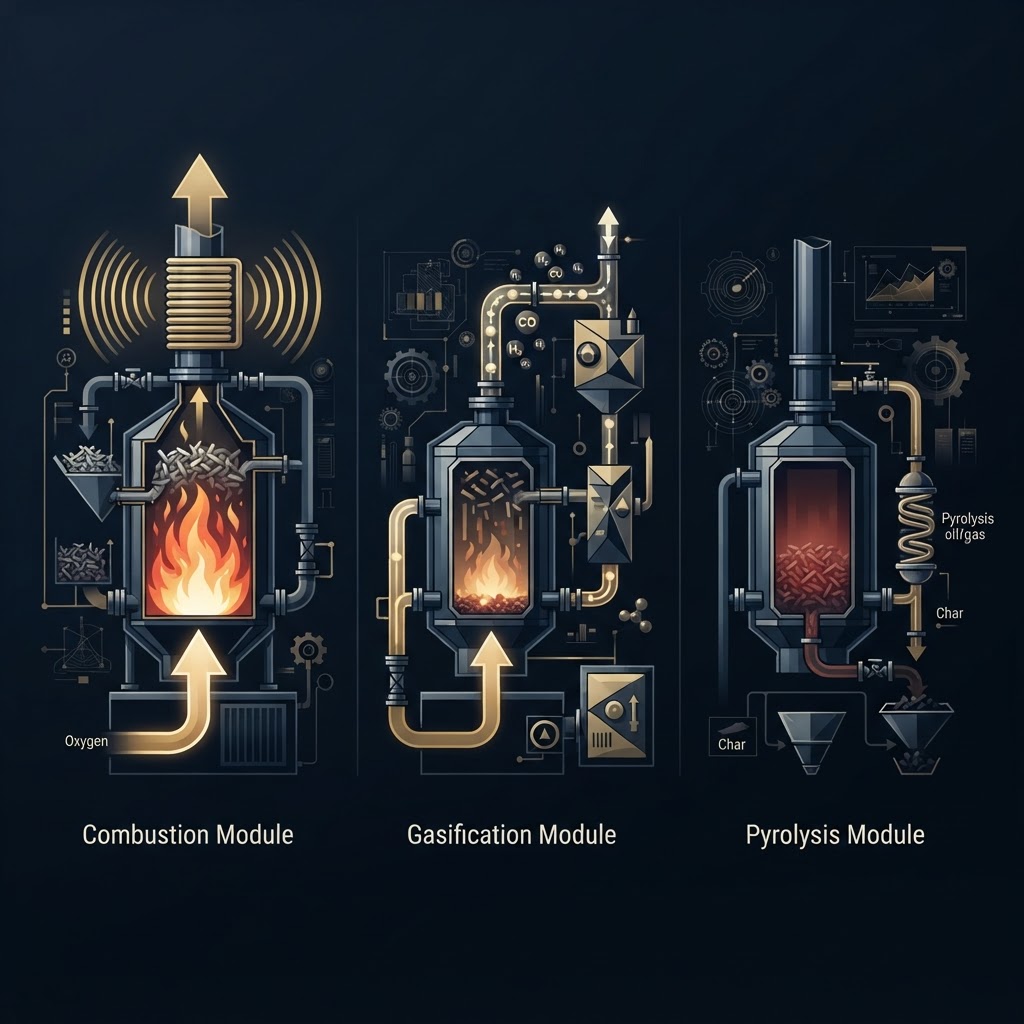
Gasification is a thermochemical process that converts carbon-based material into a combustible gas by heating it above 700 degrees C with a controlled, insufficient amount of oxygen or steam, so that it reacts without burning. The product is syngas, a mixture of carbon monoxide, hydrogen and carbon dioxide (US Department of Energy).
That is the whole answer to "what is gasification" in 40 words, and it is the same answer whether the material going in is coal, wood chips or a municipality's residual waste. Syngas is composed primarily of carbon monoxide and hydrogen, both flammable, which is why it is itself a fuel and a chemical building block (NETL Gasifipedia).
The definition is where most explainers stop. It is also where the useful part begins, because the chemistry is shared while the systems are not. Three choices decide which gasification you are actually looking at: the feedstock, the gasifying agent and the output you are designing for. We license a 150 kg per hour fixed-bed gasifier built for waste, so this page walks those three choices with real operating numbers, not a coal-plant diagram.
Gasification vs combustion vs pyrolysis
The quickest way to understand gasification is to place it between the two processes it is confused with. All three heat carbon-based material. They differ in how much oxygen is present, and that single variable decides whether the output is heat, gas or char.
| Combustion | Gasification | Pyrolysis | |
|---|---|---|---|
| Oxygen supply | Excess | Limited, below what full burning needs | None |
| Main product | Heat and flue gas | Syngas (CO, H2, CO2, some CH4) | Char, oil and gas |
| Heat balance | Releases heat | Needs heat overall; part of the fuel is oxidised to supply it | Needs external heat |
| Typical temperature | Flame temperatures | 750 to 1100 degrees C | Lower, no oxidation zone |
Penn State's alternative fuels course puts gasification at 750 to 1100 degrees C and defines its product as a gaseous mixture of CO, CO2, H2 and CH4, in direct contrast to combustion, which releases the same chemical energy as heat on the spot (Penn State EGEE 439). The gas is called syngas, short for synthesis gas, or producer gas in older usage, and it is a fuel precisely because the hydrogen and carbon monoxide it mostly consists of are flammable (Wikipedia).
The practical consequence: a combustion plant sells heat and must use it immediately. A gasifier manufactures a fuel that can be cleaned, stored briefly, burned in an engine, shifted to hydrogen or fed to a synthesis catalyst. That flexibility is the entire reason anyone chooses the harder process. We cover the head-to-head against incineration in gasification vs incineration and the zero-oxygen case in pyrolysis vs gasification.
What happens inside a gasifier
A gasifier is a high-temperature vessel, often pressurised in industrial designs, in which oxygen or air and steam are brought into direct contact with the fuel so that chemical reactions convert the feed into syngas plus mineral residues such as ash and slag (DOE FECM fact sheet). Inside, the material passes through four zones in sequence.
Drying and pyrolysis
Drying happens first, at around 100 degrees C, and the steam it releases does not simply leave: it mixes into the gas flow and takes part in the later water-gas reaction if the temperature is high enough. Pyrolysis follows as the dried material is heated further without oxygen, releasing volatile gases and tars and leaving a carbon-rich char.
Oxidation and reduction
In the oxidation zone a portion of the char and volatiles reacts with the limited oxygen supplied. This is not waste. It is the heat source that pays for everything else, since the process as a whole needs energy put in. In the reduction zone that heat drives the char, carbon dioxide and steam into carbon monoxide and hydrogen. This is where the syngas is actually made.
That is the short version. The full stage-by-stage account, with the operating parameter that governs each zone and the published composition of real municipal waste against what a downdraft reactor accepts, is in how waste gasification works stage by stage. Here the point is simpler: once you understand that oxidation funds reduction, you understand why the amount of oxygen you admit is the master dial of the whole process.
Choice 1: the feedstock
The US Department of Energy lists the carbon-based raw materials gasification handles as coal, biomass, petroleum coke, municipal solid waste, industrial wastes and waste plastics. A single fluidised-bed design from the Gas Technology Institute has been developed and tested on more than 25 different feedstocks, from various forms of biomass and wastes through metallurgical cokes to every rank of coal from lignite to bituminous (GTI gasification process).
That range is the strength of the definition and the trap inside it. Because the chemistry works on anything carbon-based, vendors describe gasification as feedstock-agnostic. In practice the feedstock decides whether a specific machine runs. Dry, uniform wood chips gasify easily. Wet, high-ash, variable waste melts into clinker in reactors designed for wood, fouls the gas path with tar and shuts plants down. Most small gasification projects that failed did not fail at the chemistry. They failed at the hopper.
So the first question about any gasification system is not "what temperature" but "which feedstock was this validated on, and for how long". Our X-150 was independently validated at the COMETHA site in Paris, at Verkoso with Fraunhofer IKTS and at Hochschule Zittau/Goerlitz on high-ash sewage sludge, municipal solid waste and digestate, the feedstocks that clean-wood gasifiers cannot handle (Zero-X partner program).
Choice 2: the gasifying agent
The second choice is what you admit into the reactor to supply the limited oxygen. There are three options, and each produces a different gas.
| Agent | What it does to the gas | Where it fits |
|---|---|---|
| Air | Cheap, but the nitrogen in air dilutes the product to roughly half nitrogen, lowers temperature and raises tar | Heat and small engine applications |
| Oxygen | No nitrogen ballast, higher temperature, a true CO and H2 syngas | Chemicals, fuels, hydrogen |
| Steam | Reforms carbon into hydrogen-rich gas; usually combined with oxygen | Hydrogen and synthesis |
The World Bioenergy Association's factsheet puts the gasification range at 700 to 1600 degrees C depending on the medium. Air gasification gives relatively low operating temperatures, more tar and about 50% nitrogen in the gas, which can still be burned for heat or run in engines once the tar is removed. When oxygen and steam are used instead, the product is a gas of carbon monoxide and hydrogen, the syngas proper (World Bioenergy Association).
The agent is a commercial choice, not a technical footnote. If the end product is hydrogen, nitrogen in the gas is dead weight that every downstream step has to handle. NETL describes the route: the carbon monoxide in syngas is shifted to hydrogen and carbon dioxide by adding steam and reacting over a catalyst in a water-gas shift reactor, after which the hydrogen is separated. The higher the hydrogen and the lower the nitrogen coming out of the gasifier, the cheaper that chain gets.
This is why our continuous campaign ran in oxy-steam mode with zero nitrogen ballast. The syngas carried 33% hydrogen at an H2 to CO ratio of 1.95 to 1 (Zero-X COMETHA campaign), a composition that an air-blown unit cannot reach because half of its output volume is nitrogen before the first molecule of hydrogen is counted.
Choice 3: the reactor and the scale
Gasification technology falls into three major groups: fixed bed, fluidised bed and entrained-flow gasifiers (Energies 2022 review). The groups differ in how the fuel and the agent meet, and that sets the scale each one makes sense at.
At the industrial end, the GTI fluidised bed runs at 840 to 1100 degrees C and at 3 to 30 bar or more depending on what the syngas is for, achieving overall carbon conversion of 95% or higher and cold gas efficiencies above 80%. Entrained-flow designs run hotter still and dominate coal-to-chemicals complexes. These are plants measured in hundreds of megawatts, built next to a mine or a refinery.
At the other end sit small fixed-bed gasifiers, documented in the World Bioenergy factsheet at 0.05 to 1 MWth of capacity. This is the class where the fuel sits in a bed and moves down or up through the zones described earlier, which is why a fixed-bed unit is sometimes called a downdraft or updraft gasifier. It tolerates less feedstock variation than a fluidised bed, which is exactly why feedstock validation matters so much at this scale, but it fits in a shipping container and runs at a hotel, a farm, a wastewater plant or a small town.
Our X-150 is a containerised 150 kg per hour fixed-bed downdraft unit, placed deliberately in that small range. The distinction between a gasifier that needs a refinery next door and one that arrives on a truck is the subject of types of gasifiers, and the economics of the small class are in small scale waste to energy systems.
What gasification produces and what it is for
Syngas is the product everything is designed around. The DOE's gasification programme lists its end uses as hydrogen, transportation fuels, chemicals and electricity, and the Energies review frames gasification as one of the major routes to hydrogen at a time when conventional coal power emits about 1.0 kg of CO2 per kWh. Which use you can serve depends on the ratio of hydrogen to carbon monoxide you can produce, which is decided by the agent choice above. The composition question has its own page in what is syngas.
Syngas is not the only output. The mineral content of the feed leaves as ash or slag, and in waste gasification at lower temperatures a stable carbon-rich char can be produced as a co-product. And the raw gas carries passengers that no engine, turbine or catalyst will accept: tar, particulates, sulphur compounds and ammonia.
This is the part of the definition that reference pages omit and that decides projects. Gas cleaning is not an accessory bolted onto a gasifier. In a waste project it is the plant. Our SyngaPure cleaning stage removes 99% of tar compounds while maintaining energy efficiency (Zero-X on waste to hydrogen), and its modular, AI-supported design with real-time sensing of tar, H2S, NH3 and particulates was selected for support under the German federal BMWK go-inno programme in December 2025 (Zero-X BMWK go-inno). Over the full continuous campaign the system logged 99.98% tar conversion. Anyone defining gasification for a buyer without mentioning tar is describing the diagram, not the machine.
A short history: from gaslight to waste-to-hydrogen
Gasification is older than the electric grid. It was first used at scale in the early 1800s to produce gas for lighting, in London in 1807 and in Baltimore in 1816. The process became the source of town gas for lighting and cooking across the industrial world, and from well before 1900 engines running on what was then called wood gas, made by gasifying dry wood, powered pumps for mines and irrigation.
The twentieth century scaled it up and moved it to coal: large pressurised gasifiers feeding ammonia, methanol and liquid fuel synthesis, and later integrated gasification power plants. The present decade is moving it back down in size and across to waste, because the hydrogen economy needs a carbon-based feedstock that is cheap, local and already being paid to be removed.
That is the lineage our machines sit in. The X-5 prototype, introduced in 2021 as the precursor to the X-150, runs at Thrive Hotel in Canggu, Bali, and an X-150 rollout office opened at Petronas University in Malaysia (EX Venture Insights, July 2024). In May 2024 the first Zero-X waste-to-hydrogen reactor became operational in Paris within the COMETHA project, fed by household waste and sewage sludge (Julien Uhlig on the Paris reactor). Two hundred years after gaslight, the same reaction is making hydrogen from what a city throws away.
What gasification looks like at 150 kg per hour
A definition is tested by a number. Here is ours. Between 2025 and 2026 the X-150 in Paris ran continuously for 1,939 hours, 80 consecutive days, and processed 16,382 kg of digestate pellets into syngas with 33% hydrogen and 99.98% tar conversion in oxy-steam mode. Every term in the definition at the top of this page is in that sentence: a carbon-based waste feedstock, a controlled oxygen and steam agent, a temperature that converts rather than burns, and a hydrogen-rich gas clean enough to use.
If you are reading this because gasification appeared in a proposal, a grant call or a council agenda, the definition gives you four questions to ask the people proposing it:
- Which feedstock was the machine validated on, and does it match ours?
- Which gasifying agent does it use, and what hydrogen and nitrogen content does that produce?
- How many continuous hours has it run on that feedstock, documented by whom?
- Who owns and guarantees the gas cleaning?
The answers separate a gasification project from a gasification diagram. They also matter financially, because in the Wave 1 markets where we are deploying, governments fund 56 to 70% of project capital cost, and that funding follows documented technology rather than promises. Gasification, defined properly, is a 200-year-old reaction that has become a practical way to turn a disposal cost into hydrogen, power and heat. Defined carelessly, it is how most small waste-to-energy projects have lost their money.
FAQ
Is gasification the same as burning?
No. Burning, or combustion, supplies excess air and releases all of the fuel's energy immediately as heat and flue gas. Gasification deliberately restricts oxygen so the fuel is only partially oxidised and most of its energy leaves in the form of a combustible gas that can be cleaned, moved and used in an engine, a turbine or a chemical process. The two share a feedstock and a high temperature and nothing else about their output.
Is gasification renewable?
The process itself is neutral; the feedstock decides. Gasifying coal or petroleum coke is a fossil process. Gasifying biomass, biogenic waste or sewage sludge is counted as renewable or recovered energy, and mixed municipal waste is typically treated as partly biogenic. The same gasifier can therefore be a fossil asset or a renewable one depending only on what is loaded into it.
Why is syngas not put into the gas grid?
Its energy content is far below natural gas. With air as the agent roughly half the gas volume is nitrogen, which carries no energy, and even oxygen-blown syngas is a carbon monoxide and hydrogen mix rather than methane. So syngas is used where it is made: burned for heat and power, shifted to hydrogen, or fed to synthesis, rather than injected into a pipeline built for methane.
Can gasification run at high pressure?
Yes. Large industrial gasifiers operate at 3 to 30 bar or more, with the pressure chosen to suit the downstream process, for example a synthesis loop that runs pressurised anyway. Small fixed-bed units of the kind that fit in a container run close to atmospheric pressure, which keeps them simpler and cheaper to permit and maintain.
How do you get hydrogen from gasification?
Choose oxygen and steam as the agent so the gas is not diluted with nitrogen, then pass the syngas through a water-gas shift reactor where carbon monoxide reacts with steam over a catalyst to form hydrogen and carbon dioxide. Separate the hydrogen from the CO2 and you have a hydrogen stream. The higher the hydrogen fraction leaving the gasifier, the smaller and cheaper every step of that chain becomes.
Available for advisory work, board seats and media appearances.
Julien Uhlig advises boards and funds and briefs newsrooms across Europe and North America. Enquiries are read personally.
We use cookies to improve your experience on this site. By continuing, you agree to our Privacy Notice.