Small Scale Waste to Energy Incinerator: Buyer's Guide
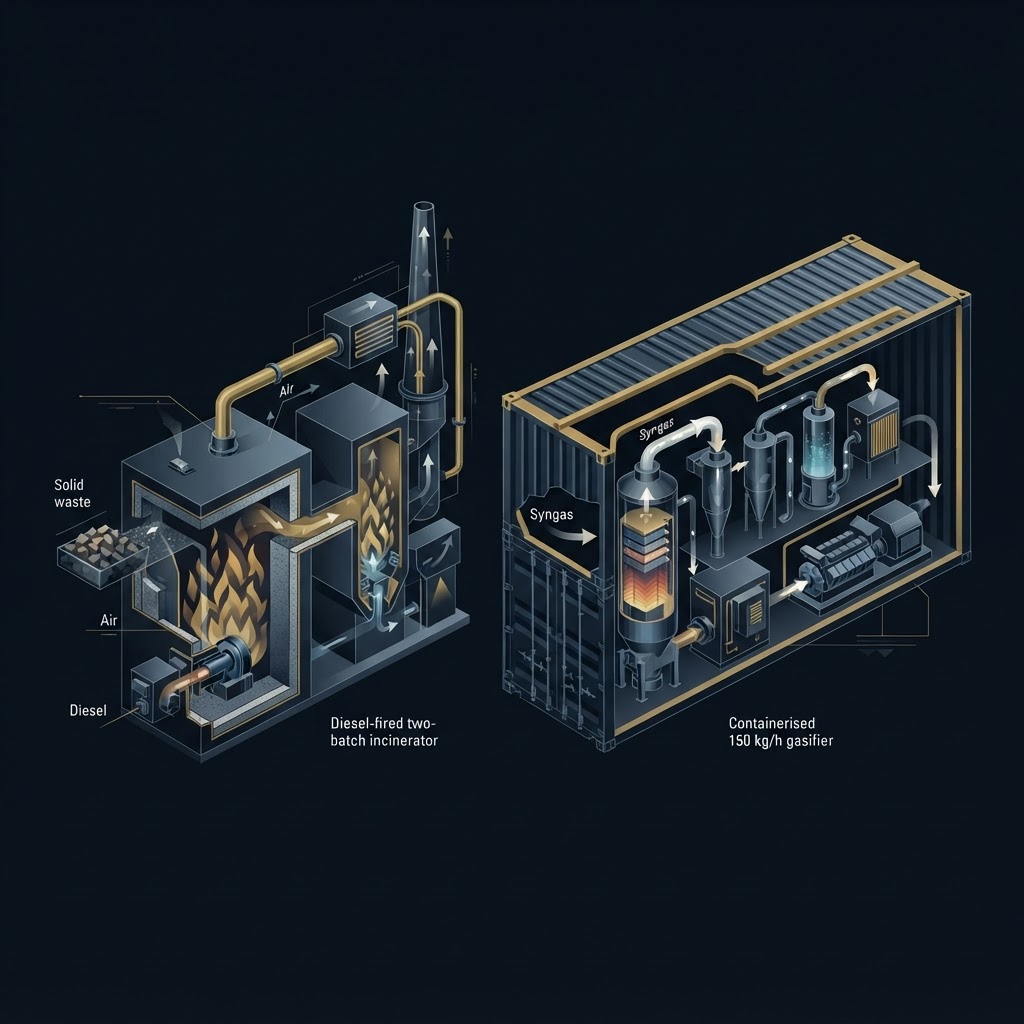
Search for a small scale waste to energy incinerator and you land in a catalogue. Burn rates in kilograms per batch, stainless chimneys, a price that looks too good, and the word "energy" somewhere in the product title.
Here is what the catalogues leave out. Most small incinerators on the market do not produce energy. They consume it. The ones that genuinely recover energy need a flue gas train that costs more than the furnace. And in the EU, calling your machine a gasifier does not get you out of incinerator rules if you burn the gas.
This guide is for the municipal buyer, hotel group or island utility holding three quotes and trying to work out which one is real. We build and license small gasification systems, so we have a view. We will state it at the end, after the numbers.
Most small incinerators on sale burn fuel, they do not make it
Read the diesel line on the spec sheet
Every honest spec sheet has one line that decides the business case, and it is not the burn rate. It is auxiliary fuel.
Take one published range of small municipal waste units. The TS100 model burns 100 to 150 kg of waste per hour and consumes an average 20.4 kg of diesel per hour doing it; the 500 to 600 kg/h model uses 44 kg/h. Do the arithmetic at the small end: roughly one kilogram of diesel for every six kilograms of waste. That machine is a disposal service you pay for in fuel. It has no boiler, no turbine and no electrical output.
That is not a criticism of the product. It is doing exactly what it was built for: destroy waste at a high enough temperature that the stack stays clean. The same specification calls for a secondary chamber that holds gas at 1,000 C for at least two seconds. Holding that temperature costs fuel when the waste is wet.
Some vendors say their burners switch off once the chamber is hot. One 30 to 50 kg/h unit claims burners shut down once the primary chamber reaches 550 C and the secondary 850 C, with 90% volume reduction. That is a vendor claim. Whether it holds depends on the calorific value and moisture of your waste, which is exactly what you should ask them to prove on a sample.
Batch ratings versus kilograms per hour
The second trap is units. A resort incinerator listed at US$4,800 is rated at 10 to 500 kg per batch, three to six batches a day, with a two hour burn-out cycle including cooling, fired on diesel or gas. A "500 kg" rating on a batch machine is not 500 kg/h. Convert everything to tonnes per day of continuous operation before you compare quotes.
Purpose-built units for hotels and resorts, like the Ecowaste range at 35 to 75 kg/h, are sold on destruction at source and lower transport, not on power. That is the honest framing for this whole product class.
What it takes for a small incinerator to actually recover energy
To turn incinerator heat into electricity you need a heat engine, usually a steam cycle or an Organic Rankine Cycle (ORC), plus a flue gas train good enough to meet emission limits. The best published techno-economic study of this at small scale is a Maldives island case, and it is worth reading closely:
- To feed a 235.2 kW ORC unit the model needed an incinerator at 752.63 kg/h, fed by 5,274 tonnes a year from an agglomeration of hotels.
- The ORC was costed at AUD 3,300 per kW, about AUD 776,000.
- The largest single contributor to capital cost was flue gas treatment, at AUD 814,156. More than the ORC, and far more than the incinerator itself.
- With a $50 per tonne gate fee and electricity selling at $0.35 per kWh, the model returned a 3.8 year simple payback and a levelised cost of AUD 0.11 per kWh.
Two conclusions for a buyer. First, the small scale energy case works only where electricity is expensive and waste disposal already costs money, which is the island and remote-resort profile. Second, if a quote for an "energy" incinerator does not show a flue gas train costing at least as much as the furnace, ask what is missing. The study's own authors suggest adding flue gas treatment in modules over time to ease financing, and concede the emissions would then not match European levels, arguing it still beats open burning. That is a defensible choice in some markets. It is not one a European permit will accept.
The emissions bill: what the rules actually ask for
EU: gasification can count as incineration
This is the point most small-system brochures skip. The EU Industrial Emissions Directive defines a waste incineration plant as any unit for thermal treatment of waste, including pyrolysis, gasification or plasma processes if the substances resulting from the treatment are subsequently incinerated.
Read that twice if you are shopping in Germany or Spain. A gasifier that feeds its syngas straight into an engine or burner is regulated as an incinerator. The regulatory advantage of gasification comes from what you do with the gas: cleaning it and using it as a product, such as hydrogen, rather than simply burning it.
The limit that sets your flue gas train
The headline number is dioxins and furans. Under Annex VI of the directive, the limit is 0.1 ng per Nm3, averaged over a six to eight hour sampling period, and the same annex refers to plants that raise gas to at least 1,100 C for two seconds. Meeting that with a small furnace is possible. Proving it with continuous monitoring on a 100 kg/h unit is where small projects get expensive, because the monitoring equipment does not shrink with the plant.
For buyers outside the EU, national limits vary. Ask which standard the vendor has tested against, with results from an independent lab rather than a line saying "emission compliance".
A real small incinerator, measured
The most useful public data on a working modular incinerator comes from Labuan Bajo in Indonesia, a tourism destination producing 14.06 tonnes of waste a day in 2020. The government installed two 10 tonne per day lines with a pre-treatment plant for sorting and thermal drying.
What the test showed:
- Primary chamber at a minimum of 800 C, secondary up to 1,000 C.
- Maximum burn rate of 527 kg/h, above the 417 kg/h design.
- Flue gas through a cyclone and quench scrubber, with continuous monitoring of particulates, CO, SO2 and NOx, all below the national standard.
- Fly and bottom ash of about 4% of input weight.
And the energy? Heat from the process goes to the thermal dryer to bring waste moisture down to 40% so it burns. That is the honest ceiling for most small incinerators: the energy recovered is spent keeping the machine running on wet tropical waste. It is a sound waste solution, not a power plant.
Why small scale can still beat trucking the waste away
Small plants cost more per tonne of capacity. An EU islands study on the Aeolian archipelago put a small plant at roughly 1,200 EUR per tonne of annual capacity against about 250 EUR for a large mainland plant. The study is about anaerobic digestion, not incineration, but the logic transfers: shipping waste off the islands cost about 0.30 EUR per kg, so treating it locally came to an estimated 180 EUR per tonne against 310 EUR per tonne for the mainland route.
Transport is the variable that flips small scale economics. The same logic shows up in our own market work: a hotel in Bali paying US$338,000 a year to truck its waste away, and island resorts running diesel at US$0.40 per kWh, both figures from our COMETHA campaign report. Where both numbers are that high, almost any well-run local solution beats the status quo. The question becomes which one leaves you with something to sell. We covered the hotel case in depth in waste to energy for hotels and resorts.
In Europe there is one more small scale tailwind. Sites under 20 MW of fuel input are, at least for now, outside the EU Emissions Trading System. Every unit discussed in this article sits far below that line.
Incinerator or gasifier: the decision rule
When a small incinerator is the right buy
Buy an incinerator when the job is destruction, not energy. Medical waste, animal carcasses, biosecurity waste at ports and farms, or a remote site where the only goal is to stop open burning. For those jobs a simple two-chamber unit with honest emissions data is cheaper, simpler and easier to permit than anything else. Do not pay a premium for an "energy" label on a machine that burns diesel.
When a gasifier earns its complexity
Choose gasification when you want a product out of the waste: electricity at scale that justifies the equipment, hydrogen, or biochar. Life cycle work supports this direction, with one assessment finding small distributed pyrolysis and gasification better for energy recovery than large incineration. For the underlying physics, see our gasification vs incineration analysis and the primer on how a gasifier works.
The catch is reliability. Small gasifiers have a long history of running beautifully on clean wood and failing on real waste, mostly because of tar. That is why we publish operating hours rather than nameplate figures. Our X-150 is a 150 kg/h containerised fixed-bed gasifier. Per the same COMETHA report, it ran 1,939 hours continuously in Paris, processing 16,382 kg of digestate pellets, with 33% hydrogen in the syngas and 99.98% tar conversion. It has been validated on high-ash sludge, MSW and digestate at COMETHA, Fraunhofer IKTS and Hochschule Zittau/Goerlitz, and its predecessor, the X-5, runs at Thrive Hotel in Canggu, Bali.
Note the size: 150 kg/h is the same class as the incinerators above. The difference is that our syngas is cleaned and used as a product, not burned in a chimney chamber at diesel's expense. If you are sizing a full site, our guides to small scale waste to energy systems and the waste to energy gasification plant cover capacity bands and revenue lines.
Questions to put to any vendor
Whatever you buy, get written answers to these before you sign:
- Net energy per tonne. Energy out, minus auxiliary fuel and parasitic power, on your waste. If the answer is negative, you are buying a disposal service.
- Continuous or batch. What is the real throughput in tonnes per day, including loading, burn-out and cooling?
- Which emission standard, measured by whom. An independent lab report, with dioxin results, not a brochure line.
- Is the flue gas train in the price? Cyclone, scrubber, bag filter, activated carbon, monitoring. In the Maldives case this was the biggest capital line.
- Ash. How much, and is the fly ash classified as hazardous where you operate? One vendor above states its fly ash is treated as hazardous waste.
- Hours on your feedstock. Continuous operating data on waste like yours, not on dry wood or a test fuel.
A vendor who answers all six clearly is worth talking to, whatever the technology.
FAQ
How much does a small waste incinerator cost?
Simple batch units start at a few thousand US dollars, with one resort model listed at US$4,800. That buys destruction, not energy. Once you add power generation and a flue gas train that meets strict limits, the budget moves into hundreds of thousands, as the Maldives study shows.
Can a small incinerator generate electricity?
Yes, but only with a heat engine attached and enough throughput to feed it. The Maldives model needed about 750 kg/h to run a 235 kW ORC unit. Below that, most small incinerators recover heat at best, often to dry their own feed.
Is a small gasifier exempt from incinerator rules in the EU?
No, not if the syngas is burned. The Industrial Emissions Directive treats gasification as incineration when the resulting gas is subsequently incinerated. The distinction only helps when the gas is cleaned and used as a product.
How much ash does a small incinerator leave behind?
The Labuan Bajo modular plant measured fly and bottom ash at about 4% of input weight. Ask whether fly ash counts as hazardous in your jurisdiction, because disposal cost follows that classification.
Available for advisory work, board seats and media appearances.
Julien Uhlig advises boards and funds and briefs newsrooms across Europe and North America. Enquiries are read personally.
We use cookies to improve your experience on this site. By continuing, you agree to our Privacy Notice.