Grants for Biochar Production: US, EU and UK Routes 2026
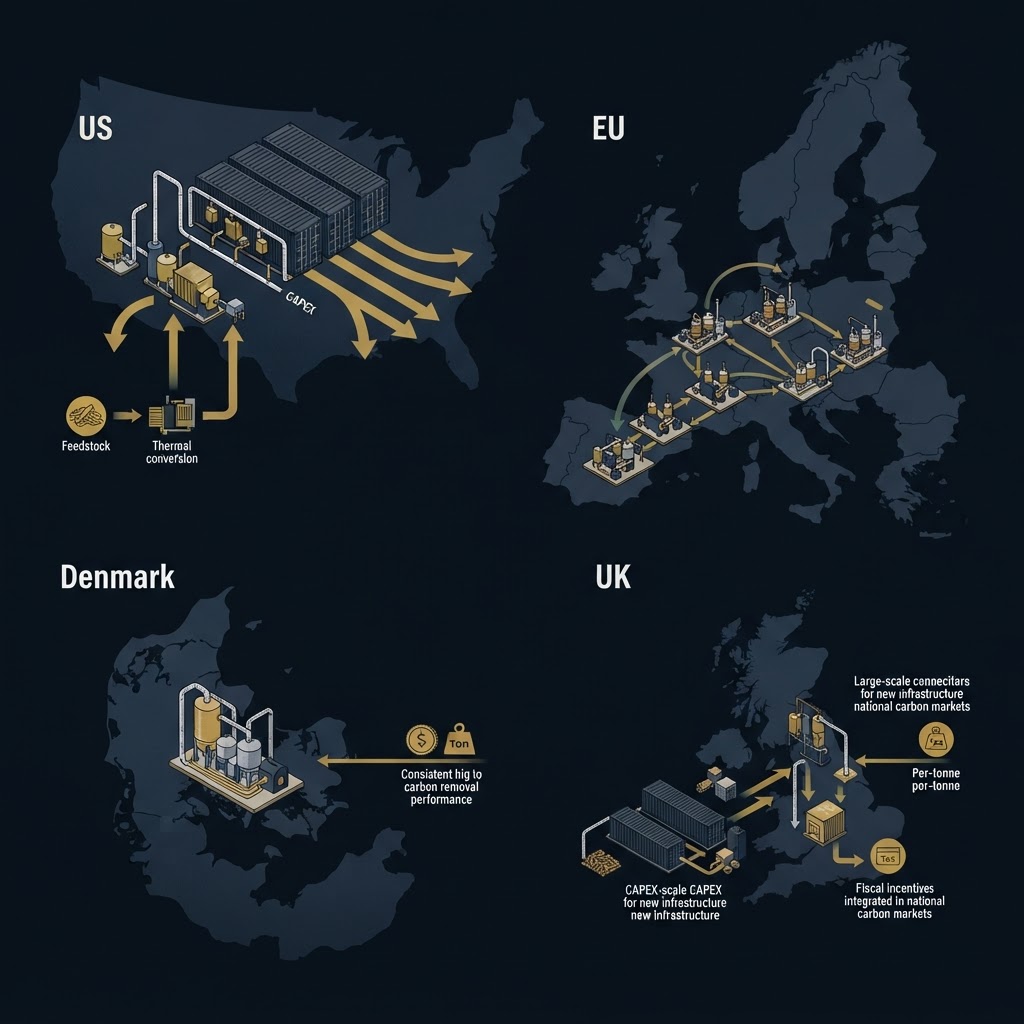
Search for grants for biochar production and you get two things: raw federal PDFs and US lists written for farmers who want to spread biochar on fields. Neither answers the question a plant developer is asking: which public money pays for the machine, which pays per tonne, and which only pays for research?
That split decides whether your project is bankable. We see it every week in Zero-X partner conversations. In our target markets, governments fund 56 to 70 percent of project CAPEX, with validated routes in Spain (70 percent), Portugal (60 to 72 percent) and Greece (56 percent). Those numbers are real, but they do not come from one grant. They come from a stack.
This guide sorts the 2026 money by what it pays for, across the United States, the EU, Denmark and the UK, and shows where feedstock quietly locks you in or out.
Three kinds of money, and why the difference matters
Every biochar funding programme falls into one of three buckets:
- CAPEX grants pay a share of equipment, installation and site works. They are one-off, competitive and usually demand that you fund the rest.
- Operating aid pays per tonne of carbon stored or product delivered, often for a decade or more. It is the closest thing to a revenue contract a government offers.
- Demonstrator and R&D funding pays for first-of-a-kind plants, trials and research consortia. Large cheques, but tied to novelty and reporting.
A lender reads these very differently. CAPEX grants cut your debt. Operating aid underwrites your revenue. Demonstrator money proves the technology but rarely repeats. The strongest projects hold at least two.
United States: federal grants for biochar production
Community Wood Energy and Wood Innovation Program
The USDA Forest Service Community Wood 2026 round funds innovative wood product facilities and thermally led wood energy systems. The numbers:
- Up to $6 million in total awards.
- Maximum $1 million per award, covering up to 35 percent of total capital costs.
- Up to $1.5 million (50 percent of capital costs) for projects that warrant special consideration, especially in high-unemployment areas.
- Matching is not required, but leverage is: at 35 percent grant you commit the other 65 percent from non-federal sources.
- For-profit businesses are eligible. The 2026 round closed April 22, 2026, and it is designed for shovel-ready projects.
This is the closest thing the US has to a federal CAPEX grant for a biochar production plant, as long as your feedstock is wood.
Forest Service biochar and urban wood grants
The Forest Service also runs a programme with biochar in its name: ALN 10.733, funded under the Bipartisan Infrastructure Law, with about $2 million estimated for FY2026 and awards of $10,000 to $100,000. For-profit organisations can apply. It is useful seed money for feasibility or crews, not a plant budget.
For urban wood, the National Urban and Community Forestry Challenge Cost Share programme offers up to $500,000 over three years for projects converting city tree waste into biochar and other products, with a 1:1 non-federal match.
USDA conservation and research money
Conservation Innovation Grants are not biochar-specific, but they fund demonstration. The FY2026 On-Farm Trials round offered $50 million, with awards from $250,000 to $5 million and a July 27, 2026 deadline. This money pays for trials with producers, so it suits biochar application research rather than production equipment. For large research partnerships, AFRI awards run $1 million to $10 million but lead with land-grant institutions.
US state programmes that fund biochar equipment
The state level is where production CAPEX gets generous. From the Jozana biochar grants tracker:
| Programme | What it pays for | Size |
|---|---|---|
| Nebraska ONE RED Biochar Incentive | Pyrolysis units, handling equipment, wiring, utility upgrades | Up to 80% of eligible costs, $4.4M pool |
| CAL FIRE Business and Workforce Development | Biochar production, pyrolysis equipment, permitting, feedstock handling | $10,000 to $3M; 1:1 match up to $500k, 2:1 above |
| Pennsylvania Agricultural Innovation | Biochar manufacturing expansion, equipment | Regional grants $100k to $2M, 50% match; one recipient got $550k for biochar |
| Minnesota ENRTF | Research, demonstration, biochar production | Recent biochar proposals $69k to $3.16M |
Two traps in the same list. California's Healthy Soils biochar practice pays farmers to buy and apply biochar but does not support on-site production. And Nebraska ONE RED requires woody organic waste as feedstock. Read the feedstock clause before the award ceiling.
Europe: LIFE, national schemes and the Danish per-tonne model
EU LIFE: what a funded biochar plant looks like
The best public benchmark for an EU-funded biochar plant is LIFE23 BIOCHAR in Austria. Total eligible budget: EUR 3,388,690. EU contribution: EUR 2,033,214, which is 60 percent. The prototype converts about 5,300 tonnes of wet biowaste a year into biochar at a composting plant, running from June 2024 to May 2027.
Note what won: a waste stream (compost screen residue) that otherwise gets burned or landfilled, a modular unit designed for replication, and heat recovery. That is the LIFE formula. Replicability is scored, not just tonnage.
Denmark: DKK 10.2 billion of operating aid
Denmark built the most ambitious biochar subsidy in Europe. The Danish Energy Agency's scheme holds a total budget of DKK 10.2 billion (2025 prices), paid from 2027 to 2045:
- Operating aid per tonne of CO2 stored in biochar applied to Danish agricultural soil.
- Pay-as-bid tender, lowest subsidy per tonne wins; one tender launched in 2026.
- Envisaged bid cap of DKK 1,750 per tonne of CO2; the estimated subsidy need is around DKK 1,000.
- Support for up to 19 years.
- Pyrolysis biochar produced in Denmark or abroad can qualify, but the bidder carries the whole value chain, including certification (likely under EU CRCF) and spreading on Danish fields.
- A claw-back is being considered if carbon credit revenues exceed a baseline, and a penalty applies if delivery falls below 80 percent.
This is operating aid, not a CAPEX grant. For a lender, a 19-year per-tonne contract is worth more than a one-off cheque.
Innovation Fund and national CAPEX routes
For larger plants, the EU Innovation Fund and national state-aid schemes carry the CAPEX share. We covered rates, ceilings and national routes in detail in our guide to government grants for waste to energy, so we will not repeat them here. The same routes behind the 56 to 70 percent CAPEX figures above apply when biochar is a co-product of a waste plant.
United Kingdom: greenhouse gas removal awards
The UK funds biochar as greenhouse gas removal (GGR). Phase 2 of the Direct Air Capture and GGR Innovation Programme awarded:
- GBP 4,997,822 for a bio-waste to biochar pilot using hydrothermal carbonisation, explicitly targeting anaerobic digestate as feedstock.
- GBP 4,994,312 for Mersey Biochar, community-scale pyrolysis tied to heat networks.
- GBP 2,997,622 for Black Bull Biochar's platform.
- GBP 2,986,349 for Ricardo's BIOCCUS pyrolysis cogeneration system.
The counterexample is just as useful. Shropshire Council funded its Ludlow biochar plant without a grant: the budget rose from GBP 2 million to GBP 3.3 million, financed by public borrowing at an assumed 4.5 percent over 20 years, targeting 2,000 tonnes of carbon removal a year. It relies on four income lines: biochar sales, carbon credits, electricity and heat. When no grant fits, the revenue stack has to carry the plant alone.
Feedstock decides which grants you can reach
Line the programmes up and a pattern jumps out. Most US federal money assumes forest wood: Community Wood, 10.733, the urban wood grant, Nebraska and CAL FIRE all tie eligibility to woody biomass. If your feedstock is sewage sludge, digestate or municipal waste, those doors are mostly closed.
Waste feedstock opens different ones: LIFE (waste diversion and replication), UK GGR (which just put GBP 5 million into digestate to biochar), and the waste to energy CAPEX routes in southern Europe. That is where gasification biochar fits. Our X-150 ran 1,939 hours continuously in Paris on 16,382 kg of digestate pellets in the COMETHA project, producing syngas and biochar from a feedstock clean-wood programmes never consider. And grant evaluators reward validated technology: our SyngaPure syngas cleaning system was selected for German BMWK go-inno support in December 2025.
If you are choosing between pyrolysis and a gasification route, read our breakdown of gasification biochar production and the biochar production equipment options before you pick a grant, because the grant will not let you change your mind later.
How to stack grants into a bankable biochar project
No single programme above funds a whole plant. Here is how the pieces fit:
- Price the plant first. Get a real biochar production plant cost before applying. Every CAPEX grant pays a percentage, so an unfunded remainder of 50 to 65 percent is normal.
- Lead with one CAPEX grant. Community Wood, a state programme, LIFE or a national route. Check the leverage or match rule: non-federal, committed, documented with letters.
- Add operating revenue. Per-tonne aid such as Denmark's, carbon credits, energy and product sales. Watch claw-back clauses that net credits against subsidy.
- Do not double count. Most schemes forbid funding the same cost twice. Separate equipment, trials and operations across programmes.
- Match feedstock to programme. Wood, waste or digestate: pick grants whose eligibility clause you meet on day one.
- Model the business without the grant. If it only works with subsidy, a delay kills it. Our guide on whether biochar production is profitable walks through the unit economics.
For how grants sit next to equity and debt in the full picture, EX Venture's piece on the waste to energy funding capital stack lays it out stage by stage. And if you want a proven machine plus the grant routes in your territory, that is what our technology licensing model is built for.
FAQ
Can a for-profit company get a grant for biochar production?
Yes. Both the Community Wood programme and the Forest Service 10.733 biochar programme list for-profit businesses as eligible applicants. Many state programmes, including CAL FIRE, also accept companies.
Do biochar grants cover buying a pyrolysis or gasification unit?
Some do. Nebraska ONE RED names pyrolysis units and installation as eligible costs up to 80 percent, and Community Wood pays up to 35 percent of capital costs for new facilities. Research programmes such as CIG generally do not pay for production equipment.
Is imported biochar eligible for the Danish subsidy?
Production can happen outside Denmark, but the biochar must be applied to Danish agricultural soil and count in the Danish greenhouse gas inventory. Denmark is still considering specific rules for biochar from outside the EU.
Can I combine a biochar grant with carbon credit sales?
Usually, but check the terms. Denmark is considering a claw-back that reduces support if credit revenues exceed a set baseline, and the stored carbon claimed under the scheme cannot be transferred to other countries.
Available for advisory work, board seats and media appearances.
Julien Uhlig advises boards and funds and briefs newsrooms across Europe and North America. Enquiries are read personally.
We use cookies to improve your experience on this site. By continuing, you agree to our Privacy Notice.