Off Grid Power Solutions: Solar, Diesel, Hybrid or Waste?
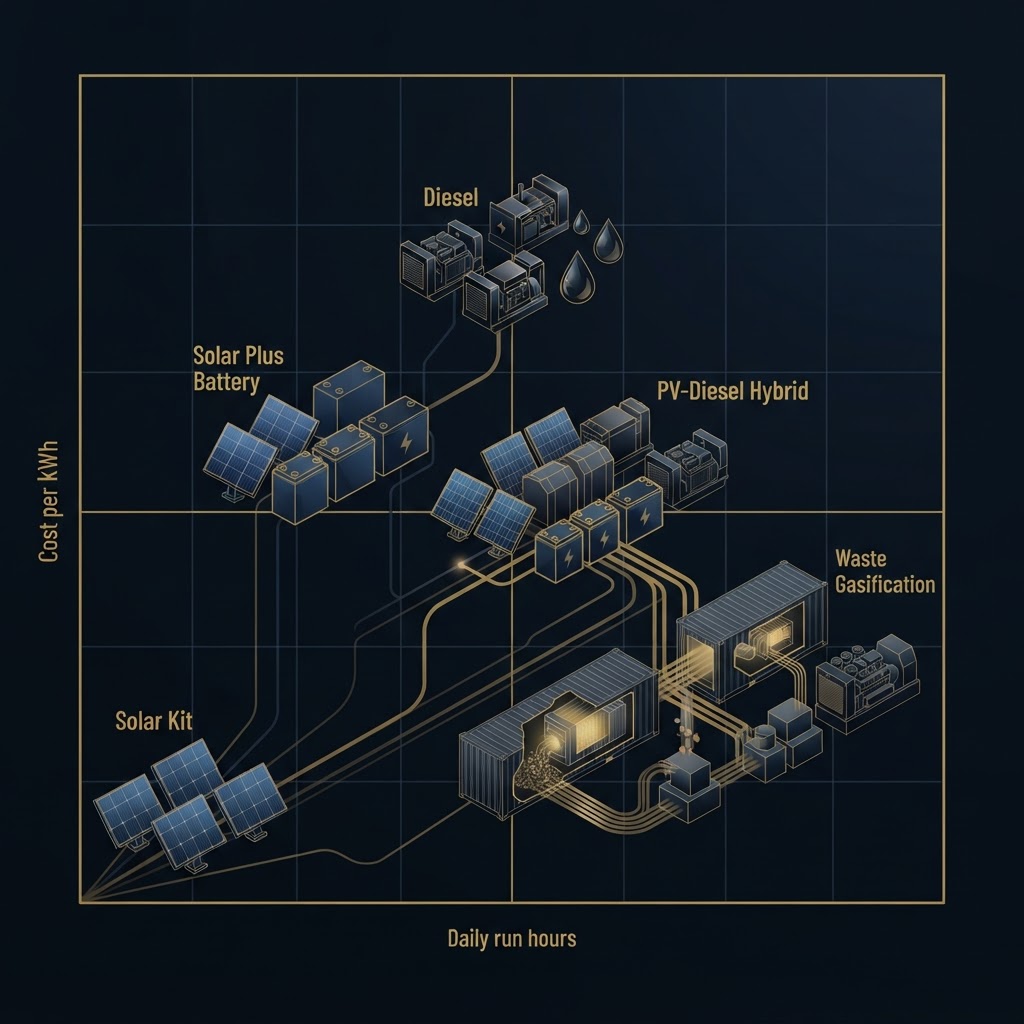
Most guides to off grid power solutions answer one question: how many solar panels and batteries do you need? That is the right question for a cabin. It is the wrong one for a resort, a clinic, a farm processing plant or a village mini-grid that has to run through the night, every night. This guide compares the five families of off-grid power by the thing that actually decides the choice, your load profile, and by the number that decides whether the project survives, cost per kWh. It is written by the team behind the X-150, a containerized waste gasifier, so we will say plainly where solar beats us and where it does not.
What counts as an off grid power solution in 2026
An off-grid system generates, stores and distributes electricity without a utility connection. The market is not niche. In 2023, 666 million people still had no electricity, and 565 million of them live in Sub-Saharan Africa, which now holds 85% of the global access gap. Add every hotel, mine, telecom tower, farm and island that has a grid on paper but not in practice, and off-grid becomes a design discipline, not an edge case.
There are three ways to bring power to a site with no grid: extend the grid, install standalone systems, or build a mini-grid. As ODI's mini-grid explainer puts it, grid extension cost rises exponentially as population density falls, and standalone solar handles lighting and phone charging but "may struggle with larger electricity loads such as powering machinery." Everything in this guide sits in the gap between those two. If your site is in Nigeria, where 86.6 million people lack access, pair this with Energaia's country guide to off-grid power solutions in Nigeria, which covers the local regulation and tariffs.
The five families of off-grid power
Solar home systems and kits
Panels, a charge controller, a small battery and an inverter. Cheap, silent and modular. Ideal for lighting, phones, fans and a fridge. Not built for motors, pumps or anything that runs at 2 a.m.
Solar plus battery storage
The residential default. A fully off-grid home setup runs from $25,000 to $70,000 or more, and most designs still list a propane or diesel backup generator for long cloudy spells. Lithium iron phosphate batteries dominate remote tenders because they routinely exceed 4,000 cycles at 80% depth of discharge. The catch is sizing: the economic optimum is usually two to three days of autonomy, and every extra day of storage is capital that sits idle most of the year.
Diesel and gas generators
Low capital cost, power on demand, no batteries required. A classic renewable energy guidebook for microenterprise still states the trade cleanly: generators have lower capital costs but higher operating costs, should run above 60% load, and their 25-year cost "escalates rapidly with increasing run hours." A generator that runs two hours a day is cheap. One that runs twenty is a fuel contract with an engine attached.
Hybrid PV-diesel-battery systems
Solar covers the day, batteries cover the evening, the generator covers the gaps. A well-sized solar and storage subsystem can cut generator run time by 60% to 80% on many projects, according to the same Tide Power guide. Hybrids are the current consensus answer for remote telecom, clinics and small community grids.
Biomass and waste gasification
A gasifier heats organic material with restricted air and turns it into a combustible gas (producer gas or syngas) that runs an engine or, once cleaned, feeds hydrogen and chemical uses. It is the only option on this list that is both renewable and dispatchable: it runs when you tell it to, at night, in the monsoon, in December in Germany. Husk Power Systems proved the model at village scale in India, loading rice husk into a downdraft gasifier every 30 to 45 minutes and wiring roughly 500 households per plant within 1.5 km. For the machine side, see our guide to the gasifier generator.
Cost per kWh: what the studies actually found
Vendor pages quote capex. Buyers pay per kWh. Here is what independent work has measured. Every figure is site-specific, so treat the table as ranges to test, not prices to quote.
| Solution | Where | Cost per kWh |
|---|---|---|
| PV, PV-diesel and PV-wind-diesel hybrids with batteries | 16 unelectrified regions of Chad | 0.367 to 0.529 USD |
| Standalone solar PV mini-grid | Rural Uttar Pradesh, India | 0.20 USD |
| Standalone biomass gasification mini-grid | Rural Uttar Pradesh, India | 0.21 USD |
| Hybrid PV plus biomass gasification | Rural Uttar Pradesh, India | below 0.17 USD |
| Rice husk gasifier mini-grids, 100 to 5,000 people | Ghana | 20 to 84 US cents |
| Husk Power Systems, generation plus distribution | Bihar, India | under 0.15 USD levelized |
| 20 kW rice husk plant serving 400 consumers | South Asia model | 0.27 USD with full grant, 0.40 to 0.49 USD without |
The Uttar Pradesh rows come from a single HOMER Pro study of solar, biomass and diesel mini-grids, which is the cleanest like-for-like comparison we found. Two findings from it matter more than the headline numbers. First, both renewable options came in at around half the cost of diesel generation (26.5 INR/kWh). Second, standalone biomass gasification was the cheapest single source when high reliability was required, because solar needs a large battery bank to cover the night while a gasifier simply keeps running.
Diesel is not always the loser. A 2025 Brazilian farm study found the diesel generator at R$1.27/kWh against R$1.64/kWh for off-grid PV with batteries, under its specific load. The lesson is not "diesel is cheap." It is that small, short-duty loads favour the machine with the lowest capital cost.
Match the solution to the load profile
Small or daytime loads
Lighting, phones, a few fans, daytime pumps, office equipment. Go solar with modest storage. Nothing else on this list competes, and anyone selling you a gasifier for a 3 kW daytime load is selling you the wrong machine.
Evening and 24/7 loads
Cold rooms, kitchens, water treatment, clinics, hotel back-of-house, agro-processing that runs two shifts. This is where battery-only designs get expensive, because you are buying storage to carry the whole night. The choice becomes which dispatchable source anchors the hybrid: a diesel genset or a gasifier. The Uttar Pradesh study also warns that maintenance-heavy gasifiers must be oversized to hit near-zero shortfall, so the robustness of the machine matters as much as its sticker price.
Remote sites with fuel logistics
Islands, mines, border towns, resorts at the end of a bad road. Every litre of diesel that is trucked, barged or flown in costs far more than its pump price, and on containerized projects logistics, customs and site preparation commonly add 30% to 50% on top of equipment cost. If the site also pays to haul its own waste away, you are paying twice: once to import fuel and once to export energy.
Where waste gasification beats diesel and batteries
Put the three conditions together (a 24/7 load, expensive imported fuel, and a steady waste or residue stream) and gasification stops being an exotic option. Zero-X's own cost examples for the X-150 point at island diesel around $0.40/kWh and $338K a year in hotel waste hauling as the kind of bill a gasifier attacks from both ends.
The historical reason gasifiers failed is not the chemistry. It is tar, which condenses in pipes and kills engines, and it is why most small gasifiers are limited to clean, dry wood. That is the problem we built around:
- Duration. In the COMETHA campaign in Paris, an X-150 ran 1,939 hours (80 consecutive days) continuously, processing 16,382 kg of digestate pellets, with 99.98% tar conversion and 33% hydrogen in the syngas (same post as above).
- Gas cleaning. Our SyngaPure system removes 99% of tar compounds while keeping energy efficiency, and was selected for German BMWK go-inno support in December 2025 for its real-time tar, H2S, NH3 and particulate sensing. More on the engineering in tar removal from syngas.
- Feedstock. The X-150 is a 150 kg/h fixed-bed downdraft unit, independently validated at COMETHA, at Fraunhofer IKTS (Verkoso) and at Hochschule Zittau/Goerlitz on high-ash sludge, MSW and digestate that clean-wood gasifiers cannot handle.
- Hospitality. Our X-5 prototype, the X-150's predecessor, is operational at Thrive Hotel in Canggu, Bali. If you run a property, start with waste-to-energy for hotels and resorts.
The byproducts count too. Husk Power found that carbon offsets and char sales could each add about 10% to plant revenue, and a gasifier's char is the starting point for biochar markets we cover in biochar production in Nigeria.
The honest limits
Gasification is not a free lunch, and the SERP rarely says so.
- Capital. DESI Power estimated a 100 kW gasifier plant at $80,000, against $10,000 for a 20 x 5 HP diesel set. At low utilization that capex gap dominates your cost per kWh.
- Feedstock risk. Husk Power had to build its own rice mills and sign long-term contracts after suppliers raised husk prices. Secure the feedstock before you buy the machine.
- Operations. A gasifier needs trained operators. Husk Power's plants averaged 93% availability, over 28 days a month, with four staff per plant.
- Solar still wins the daytime. In the Indian study, standalone PV beat standalone biomass on cost. The winning design was the hybrid.
That last point is our actual recommendation: PV for the daylight kilowatt-hours, a gasifier for the night and the monsoon, batteries sized for hours rather than days, and diesel demoted to emergency backup.
How to scope an off-grid project
- Log the load curve. Hourly data across dry and wet seasons gives you peak demand, daily energy and the longest continuous load block. Those three numbers size the inverter, battery and dispatchable source.
- Audit the fuel you already have. Tonnes per day of food waste, sludge, crop residue, husks or wood offcuts, and what you pay to remove them today.
- Set a reliability target. "Lights most evenings" and "cold chain never fails" are different systems with different prices.
- Price the whole chain. Freight, duties, site works and O&M, not just the ex-works quote.
- Chase the grants. In Zero-X's Wave 1 markets (Andalusia, Alentejo, Patras), public programmes cover 56% to 70% of project CAPEX.
For the plant-size question, our overview of small-scale waste-to-energy systems walks through what a 150 kg/h unit can and cannot carry.
FAQ
What is the cheapest off grid power solution?
It depends on when you use the power. For small and daytime loads, solar with modest battery storage is cheapest. For loads that must run through the night, hybrids win: in rural India, a solar plus biomass gasification hybrid delivered the lowest cost of any design studied, below 0.17 USD per kWh.
Can an off-grid system run a business 24 hours a day?
Yes, if it includes a dispatchable source. Batteries alone become expensive beyond two to three days of autonomy, so continuous operations pair solar and storage with a generator or gasifier that can run on demand, with remote monitoring handling the switching unattended.
How much does an off-grid power system cost?
A fully off-grid home typically costs $25,000 to $70,000 or more. A pre-integrated hybrid for a 2 to 3 kW telecom site often costs $25,000 to $60,000 ex-works, with logistics and site preparation adding 30% to 50%. Community and commercial systems should be compared on cost per kWh, not capex.
Is biomass gasification reliable enough for off-grid power?
It can be, if the gas is clean and the operators are trained. Husk Power's village plants averaged 93% availability, and an X-150 has run 1,939 hours continuously on digestate pellets. Tar is the failure mode to ask every supplier about.
Available for advisory work, board seats and media appearances.
Julien Uhlig advises boards and funds and briefs newsrooms across Europe and North America. Enquiries are read personally.
We use cookies to improve your experience on this site. By continuing, you agree to our Privacy Notice.