Waste to Energy in Bali: What Hotels Can Do Before 2028
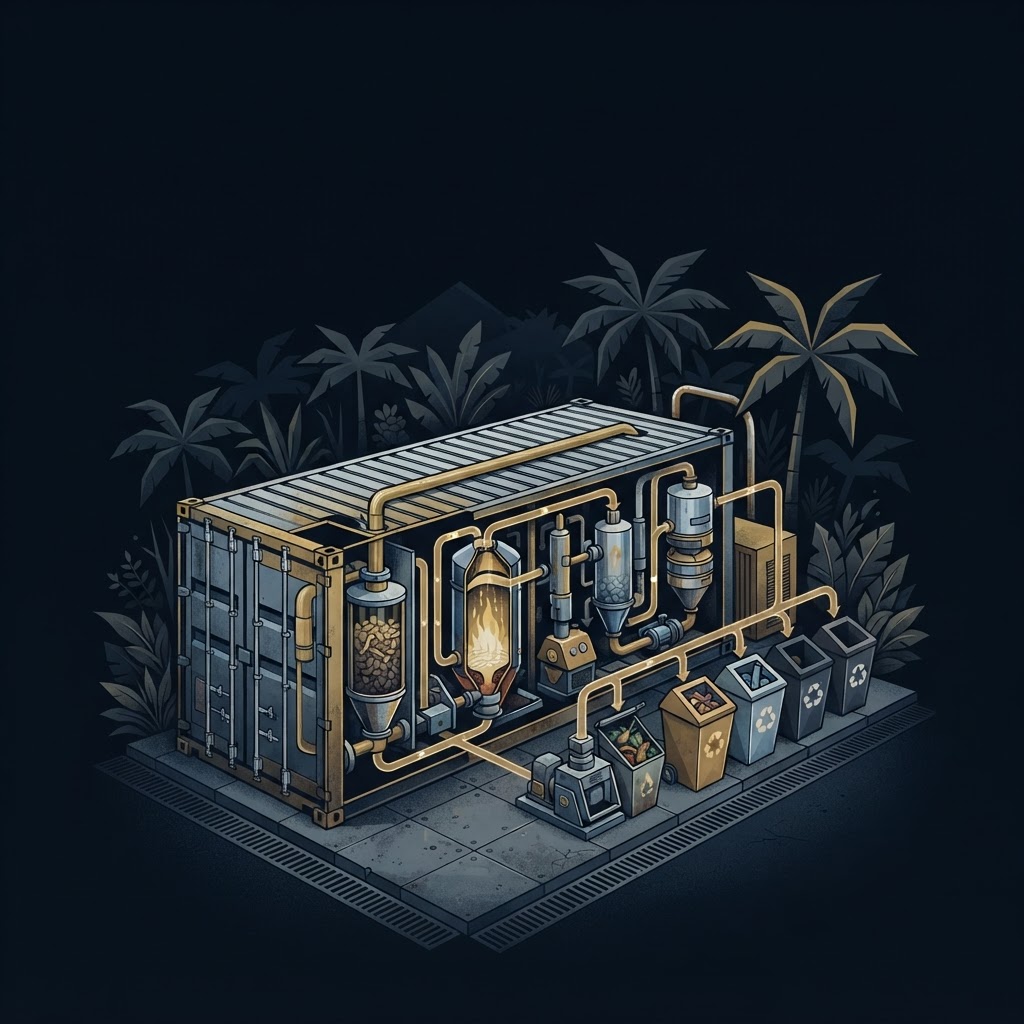
Waste to energy in Bali currently means two different things, and most of the coverage only talks about one of them. The first is a single municipal plant, now a construction site outside Denpasar. The second is a machine that sits behind a hotel kitchen and converts the property's own waste before it ever reaches a truck. We know the second one first hand: Zero-X's X-5 prototype, the precursor to the X-150, has been operational at Thrive Hotel in Canggu.
If you run a hotel, a villa portfolio or a beach club, the difference between those two matters more than any capacity figure. One will eventually take the municipal collection of two regencies. The other is what you do with your waste this year.
The municipal plant: what it covers and when
Construction started on 8 July 2026. The coordinating minister's statement gives an 18 month build, operations by late 2027 and 1,400 tonnes of waste a day, on an island generating about 3,500 tonnes daily. The site is in Pedungan, South Denpasar, next to the Suwung landfill, run by PT Wiming Nusantara New Energy and expected to power 100,000 households. The operator's own sheet says 1,500 tonnes a day, moving grate incineration and commercial operation in the first half of 2028, and Indonesia's environment minister has put completion at two to three years.
Our sister company MFC Energy has written the full breakdown of Bali's waste to energy plant, including why those numbers disagree. For a property owner the summary is short: it is a city scale incinerator for collected municipal waste, and it is not running before late 2027 at the very earliest.
Why businesses own their waste problem right now
The organic ban and the residual-only gate
The plant is the long answer. The short answer arrived on 1 April 2026, when the province banned organic waste from Suwung, a landfill that had been taking around 1,000 tonnes a day, two thirds of it organic, with full closure planned for 1 August. In response Badung set up 42 recycling depots and Denpasar 23 units processing about 72.83 tonnes a day.
The policy has wobbled since. In June the provincial government partially reopened Suwung to organic waste two days a week. Do not plan around the wobble. The direction is fixed: source sorting is mandatory for villas, hotels and restaurants, landfills are residual only, unsorted bins may simply not be collected, and waste plans are increasingly tied to UKL-UPL environmental permits and NIB business licences.
Hotels are a third of the load
Hospitality is not a bystander here. The deputy chairman of the hotel and restaurant association PHRI puts hotels, restaurants and cafes at 30 to 40 percent of all waste in Denpasar and Badung, against daily totals of 1,110 tonnes in Denpasar and 876 tonnes in Badung. That is Canggu, Seminyak, Kuta, Jimbaran, Nusa Dua and Sanur. With the island at roughly 65 percent organic and 15 percent plastic, the fraction the landfill now refuses is exactly the fraction a kitchen produces most of.
Three on-site routes, and what each actually produces
Fast composters
This is what the market is buying first. A group of top-end PHRI hotels has pooled funds for machines that turn organic waste into compost in under six hours, costing IDR 200 million to IDR 1 billion each, with one unit meant to be shared by several contributing hotels and a site still to be found, pointing to the Berawa area as a model. That solves the gate problem for food waste. It recovers material, not energy, and it does nothing for packaging or mixed residual.
Anaerobic digestion
Digestion turns the same organic fraction into biogas you can burn for heat or power. It is genuine energy recovery, and its ceiling is its feedstock: kitchen and garden waste only. Our guide to waste to energy for hotels and resorts compares resort digesters with published output figures.
Thermal conversion: gasification
Gasification takes organic waste, residual waste and sludge at high temperature with limited oxygen and produces a fuel gas rather than a flame. Zero-X's platform in this class is the X-150, a containerized 150 kg/h fixed-bed downdraft gasifier validated on high-ash sludge, MSW and digestate. It is the only route of the three that addresses both the organic fraction and the residual fraction on one site, and the only one that puts power back on the property from mixed waste. For how the capacity classes compare, see small scale waste to energy systems.
Bali's waste is wet, and that changes the machine
Two thirds organic means high moisture, and moisture is a fuel property. Every kilogram of water has to be driven off before the waste gives anything back.
The best data on this comes from the island itself. Researchers at Udayana University and the Bali State Polytechnic gasified municipal waste taken from a Denpasar landfill and changed only the gasifying agent. The syngas came out at 3.7 MJ per cubic metre with air, 8.6 with CO2 and 11.9 with steam, with the H2 to CO ratio rising from 0.6 to 1.3 and hydrogen reaching 28.6 percent.
Same rubbish, three times the gas quality, from a design choice. That lines up with what we see at larger scale: in oxy-steam mode the X-150's Paris COMETHA campaign ran 1,939 continuous hours on digestate pellets with 33 percent hydrogen in the syngas and 99.98 percent tar conversion. Wet tropical waste makes tar the question to ask every vendor, and we explain why in tar removal from syngas.
What running a gasifier at a Canggu hotel taught us
We have not published operating figures for the X-5, so none appear here. What a working prototype behind a Canggu hotel does teach is where the real problems sit, and none of them are in the reactor.
Sorting is an operations job, not a policy. A gasifier wants the stream it was designed for. Glass, metal and batteries have to come out before feeding, and that discipline lives with housekeeping and kitchen staff on every shift. The same sorting the province now demands is what keeps a unit inside its spec.
Wet season is a design input. Moisture swings between months. A system dried and tuned for August will behave differently in January unless drying and control are built for it.
Siting is about trucks, noise and neighbours. Canggu properties are dense. A containerized unit fits in a back-of-house yard, but deliveries, drying and ash handling need to be planned around guests, not squeezed in afterwards.
Somebody has to own it. A machine without a trained, accountable operator becomes a very expensive storage container. Certified operation and maintenance is part of the package or the project fails quietly.
The avoided bill is bigger than the energy. Zero-X benchmarks hotel waste hauling on the island at $338,000 a year. Electricity is the visible output. The disposal contract that shrinks is usually the stronger line in the business case.
A decision path for a Bali property
- Audit before you buy. Weigh a month of organic, recyclable and residual waste separately. Every sizing decision starts there.
- Solve the gate first. If you only need organics off site quickly, a shared composter is the cheapest compliant step.
- Model the residual and energy lines. If haulage and diesel or grid costs are material, price thermal conversion against both bills, not one.
- Pool feedstock. A cluster of villas or hotels can keep one unit fed where a single property cannot, the same logic PHRI members are using for composters.
- Ask for hours on wet feedstock. Continuous operating hours on waste like yours, a gas cleaning specification, and who operates the unit in year three.
- Look at funding and ownership. Build-own-operate models let a developer carry the asset while the property supplies waste. Our guide to government grants for waste to energy covers how public money is structured, and off grid power solutions covers where waste fits beside solar and diesel.
FAQ
Is there a waste to energy plant in Bali? Yes, but it is under construction. Work began on 8 July 2026 in Pedungan, South Denpasar, with operations targeted for late 2027 by the government and the first half of 2028 by the operator. Until then no municipal waste is converted to power on the island.
Can a hotel in Bali still send organic waste to Suwung? Organic waste has been banned since 1 April 2026. A partial reopening two days a week was reported in June, but treat that as temporary. Collectors increasingly refuse unsorted bins, so a property needs its own route for organics.
Does composting count as waste to energy? No. Composting recovers nutrients and volume, not energy. Anaerobic digestion recovers energy from organics as biogas, and gasification recovers energy from organics and residual waste as syngas.
Can several villas share one on-site system? Yes, and it is often the only way to keep a unit fed. PHRI member hotels are pooling funds for shared composting equipment, and the same logic applies to digesters and gasifiers, provided sorting is consistent across every property that contributes.
Available for advisory work, board seats and media appearances.
Julien Uhlig advises boards and funds and briefs newsrooms across Europe and North America. Enquiries are read personally.
We use cookies to improve your experience on this site. By continuing, you agree to our Privacy Notice.