What Does a Waste to Energy Plant Cost? 2026 Numbers
Ask how much it costs to build a waste to energy plant and you will get a number between two hundred thousand dollars and seven hundred million. Both are correct. They describe different machines solving different problems, and almost every cost guide online answers only for the largest of them.
That matters because the reader asking the question usually does not have a city. They have a hotel, a palm oil mill, an island, a sewage works or a district producing three to thirty tonnes of waste a day. Applying a municipal incinerator benchmark to that site produces a number that is wrong by an order of magnitude and a conclusion that the project is impossible.
Here are the three scale classes with sourced numbers for each, followed by the argument that matters more than any of them: at small scale, capital cost is not the line that decides your bill.
The short answer, by scale class
City-scale mass burn, above 100,000 tonnes per year. The institutional benchmark comes from the EIB's JASPERS advisory team, which puts capital unit costs at roughly 500 to 1,100 EUR per tonne per year of mixed municipal waste capacity. Public procurement results for six Polish facilities landed inside that band at 680 to 1,083 EUR per tonne of installed capacity. An empirical curve fitted to international incinerator builds, I = 2.3507 x C^0.7753 where I is investment in million USD and C is capacity in thousand tonnes per year, returns about USD 83.5 million for a 100,000 tpa plant and USD 169 million for a 250,000 tpa plant.
Mid-scale gasification, roughly 10,000 to 75,000 tonnes per year. A 2026 peer-reviewed review puts gasification capital costs at USD 1,500 to 3,000 per kW of installed capacity, higher per kW than conventional incineration, and small-scale pyrolysis at USD 5 to 10 million for 50 to 100 tonnes per day.
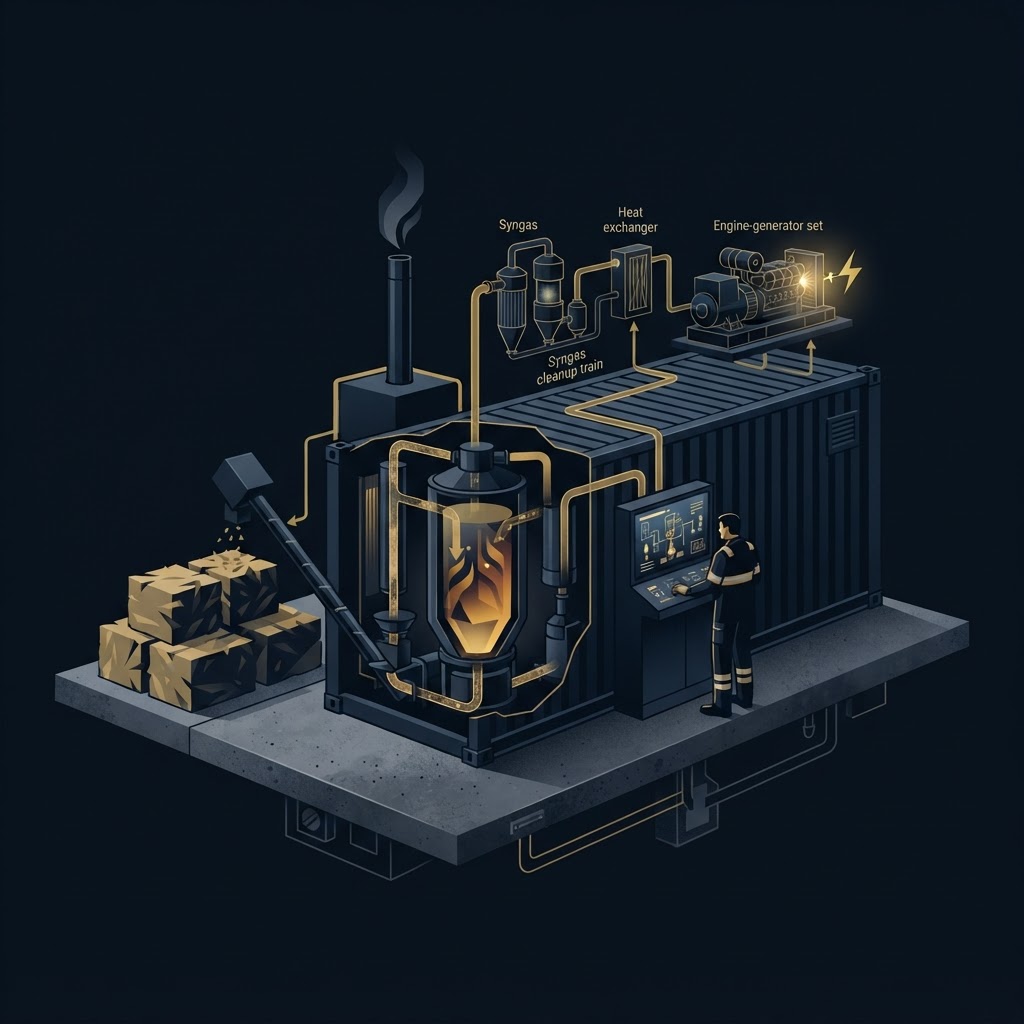
Containerized small scale, under 10 tonnes per day. A published techno-economic study of a 60 kW downdraft gasifier processing 2.4 tonnes per day gives the full build-up: USD 112,500 in equipment, USD 211,338 as total project investment once contractor labour, indirect costs, a 15 percent contingency and commissioning are added.
Three classes, three orders of magnitude. They are not competing estimates of one number.
Why the number you find online is almost always the wrong scale
There is a specific reason the published benchmarks all sit above 100,000 tonnes per year, and it is not laziness. JASPERS states that the viability of plants below 100,000 t/year should be carefully assessed. An Energy Reports analysis of decentralised municipal waste treatment is blunter: below around 100,000 t/y of input waste, direct combustion is not economically viable, which is why grate systems simply leave the market at small scale. The same paper argues gasification remains economically sustainable below that threshold, on flexibility and modularity, which is the technical reason gasification and incineration differ in where they make sense.
So the cost curves are fitted to the region where grate incinerators exist. Extrapolate one downward and you are pricing a machine nobody builds at that size. The exponent in the incinerator formula, 0.7753, is an economy-of-scale term. Run it below its fitted range and it does not merely lose accuracy, it describes a different technology.
The UK's advanced gasification review makes the same boundary visible from the other side: commercial-scale fluidised bed gasifiers are sized for 75,000 to 100,000 tpa throughput, while modular pyrolysis units run 7,000 to 10,000 tpa each. Below that again is the containerized class, and there the published literature thins to case studies. That gap is why small-scale waste-to-energy systems are so often quoted from a spreadsheet built for something else.
What actually sits inside the capital cost
At municipal scale the split is well documented. JASPERS breaks it down as building and civil works 35 percent, furnace and boiler package 30 percent, flue gas cleaning 10 percent, turbine and generator 10 percent, SCADA and electrical 7 percent, project development 5 percent, with waste reception and auxiliary equipment making up the remainder.
Read that list carefully and one thing stands out: the single largest item is concrete, not process equipment. Which is exactly what containerization removes. A factory-built unit arrives with its structure, so the 35 percent line collapses toward a foundation slab and connections. That is the mechanism behind small-scale cost claims, and it is also why the municipal percentage split cannot be scaled down to estimate a modular system.
The line small-scale models miss is on the other side of the reactor. The UK review names syngas cleanup and upgrading as significant costs that must be included in project financial models, and places most reviewed gasification technologies at TRL 6 to 8, meaning not yet commercially proven. Tar is where gasification projects die: unremoved, it fouls engines and shuts plants down inside weeks. Zero-X built SyngaPure, a modular gas cleaning system with real-time tar, H2S, NH3 and particulate sensing under AI control, for that reason. It was selected for German federal BMWK go-inno support in December 2025. Any quote that has no gas cleaning line is not cheaper. It is incomplete.
The number that decides the bill is not CAPEX
This is the part the cost guides skip, and it is the most useful thing on this page.
A 2025 techno-economic study of small-scale gasification CHP modelled a 225 kW plant and then ranked which input moved the levelized cost of energy most. At 7,500 operating hours per year the plant produced power at 388 EUR per MWh; drop it to 5,000 hours and the figure rises to 524 EUR per MWh, a 35 percent increase. A 25 percent cut in unit capital cost, by contrast, only pushed LCOE below 300 EUR per MWh if fuel also stayed cheap. Annualized capital is 47 percent of the LCOE and fuel 36 percent, so uptime, which determines how much output that capital is recovered against, outranks the purchase price you negotiated.
Put plainly: a plant that runs beats a plant that was cheap. Which is why the number worth demanding from any supplier is not a price, it is continuous operating hours on your feedstock. Zero-X's answer to that question is a 1,939-hour continuous campaign in Paris, 80 consecutive days processing 16,382 kg of digestate pellets at 99.98 percent tar conversion and 33 percent hydrogen in the syngas, with the platform independently validated at COMETHA, Fraunhofer IKTS and Hochschule Zittau/Goerlitz on high-ash sludge, MSW and digestate.
The second variable that inverts the model is what the feedstock costs. The Italian study assumed clean wood purchased at 70 EUR per tonne, a cost line. Waste arrives with the opposite sign. UK landfill disposal runs on the order of GBP 100 per tonne with gate fees between GBP 40 and 120 per tonne, and a hotel in Bali pays around USD 338,000 a year simply to truck its waste away, on an island where diesel power costs USD 0.40 per kWh. When your fuel pays you to take it and displaces expensive power, the same machine that looks uncompetitive on purchased biomass looks very different. That is the entire case for waste-to-energy at hotels and resorts.
Public capital: the 56 to 70 percent nobody puts in the model
Almost no cost article models the subsidy, which is strange, because at municipal scale the subsidy is often the reason the plant exists.
The Gdansk waste-to-energy CHP is the documented example. A plant treating up to 160,000 tonnes of residual municipal waste per year, with 45 MW thermal and 16.9 MW electrical capacity, required a public aid measure notified to the European Commission under state aid case SA.55100 before it could be built, with a company owned by the City of Gdansk as beneficiary. A well-sited, high-efficiency plant in an EU member state still did not close on private capital alone.
The same lever is available at small scale, and it moves further than any equipment negotiation. Governments fund 56 to 70 percent of project CAPEX in Zero-X's target markets, through validated routes including 70 percent under IER in Cadiz and Andalusia, 60 to 72 percent under SICE in Portugal's Alentejo, and 56 percent in Patras, Greece. Run the arithmetic against a project with a one million euro capital cost: negotiating 10 percent off the equipment saves you 100,000 euros of equity, while qualifying for a 60 percent grant saves you 600,000. The grant instrument is a design input, chosen before the site is specified, not paperwork filed afterwards. We treat it that way in our guide to government grants for waste-to-energy projects.
Operating cost and payback, honestly
Operating cost at municipal scale runs 40 to 80 EUR per tonne of mixed municipal waste, per JASPERS, with maintenance the largest share at about 25 percent and salaries about 20 percent. The 60 kW case study reports O&M of USD 0.196 per kWh over a 20 year life.
Two cost lines get left out of first-pass models often enough to name them. The first is replacement: a boiler or turbine has an economic life of 12 to 15 years and flue gas treatment equipment 8 to 10 years, so a 25 year project contains a reinvestment. The second is time. Project preparation alone runs about two years at best against a plant lifespan of 20 to 30 years, and JASPERS observes that developers systematically underestimate required capital investment at the preparation stage.
On payback, the honest ranges are 7 to 15 years overall, with incineration plus CHP at 7 to 10 years and gasification at 10 to 15. The 60 kW study achieved a 7.7 year payback and a 10.9 percent IRR, but only because a municipal solid waste tipping fee of USD 55.11 per ton sat in the model. Take the gate fee out and the same plant does not clear its cost of capital. Cost and return are separate questions, and whether the plant is profitable depends on the revenue stack, not the invoice.
How to get to a real number for your site
A range becomes a quote when five inputs are known:
- Tonnes per day, and realistic hours per year. Not nameplate capacity. Availability is the variable that dominates the LCOE, so an honest 6,000 hours beats an optimistic 8,000.
- Feedstock ash and moisture. High-ash sludge, digestate, straw and empty fruit bunches shut down systems designed around clean wood. This is a specification, not a detail.
- The sign on your fuel. Whether waste arrives with a gate fee or is purchased flips roughly a third of the operating cost from a debit to a credit.
- Energy offtake and its local price. Displacing diesel at USD 0.40 per kWh is a different business from exporting to a grid at wholesale.
- Which grant instrument the site qualifies for. Eligibility rules shape the technology choice and the timeline, so establish them first.
And one question to ask every supplier before comparing prices: how many continuous hours has this machine run on a feedstock like mine, and who verified it. In a sector where most technologies sit at TRL 6 to 8, that answer separates a plant from a pilot more reliably than any number on a quote.
FAQ
How much does a small waste to energy plant cost? It depends on which kind of small. The peer-reviewed review puts small-scale pyrolysis at USD 5 to 10 million for 50 to 100 tonnes per day, while the published 60 kW downdraft case at 2.4 tonnes per day totals USD 211,338 in project investment. Those two sit at opposite ends of what "small" means, so fix your tonnes per day before collecting quotes.
How long does it take to build a waste to energy plant? Project preparation alone typically runs about two years at best before construction, against a designed plant lifespan of 20 to 30 years. Permitting, grid interconnection studies and grant approval usually set the schedule rather than fabrication, and containerized systems compress the construction phase without compressing the permitting phase.
Why do so many gasification projects fail before commercial operation? Technology readiness, not budget. Most reviewed advanced gasification technologies sit at TRL 6 to 8, and syngas cleanup is repeatedly named as the cost line that breaks financial models. The reliable filter is documented continuous operating hours on your actual feedstock, independently verified.
Do governments pay for waste to energy plants? Often, and at municipal scale sometimes necessarily, as the notified state aid behind the Gdansk plant shows. Validated routes in Zero-X's target markets cover 56 to 70 percent of project CAPEX, which is why grant eligibility belongs in the technology decision rather than after it.
We use cookies to improve your experience on this site. By continuing, you agree to our Privacy Notice.