How Does Waste Gasification Work? Step by Step
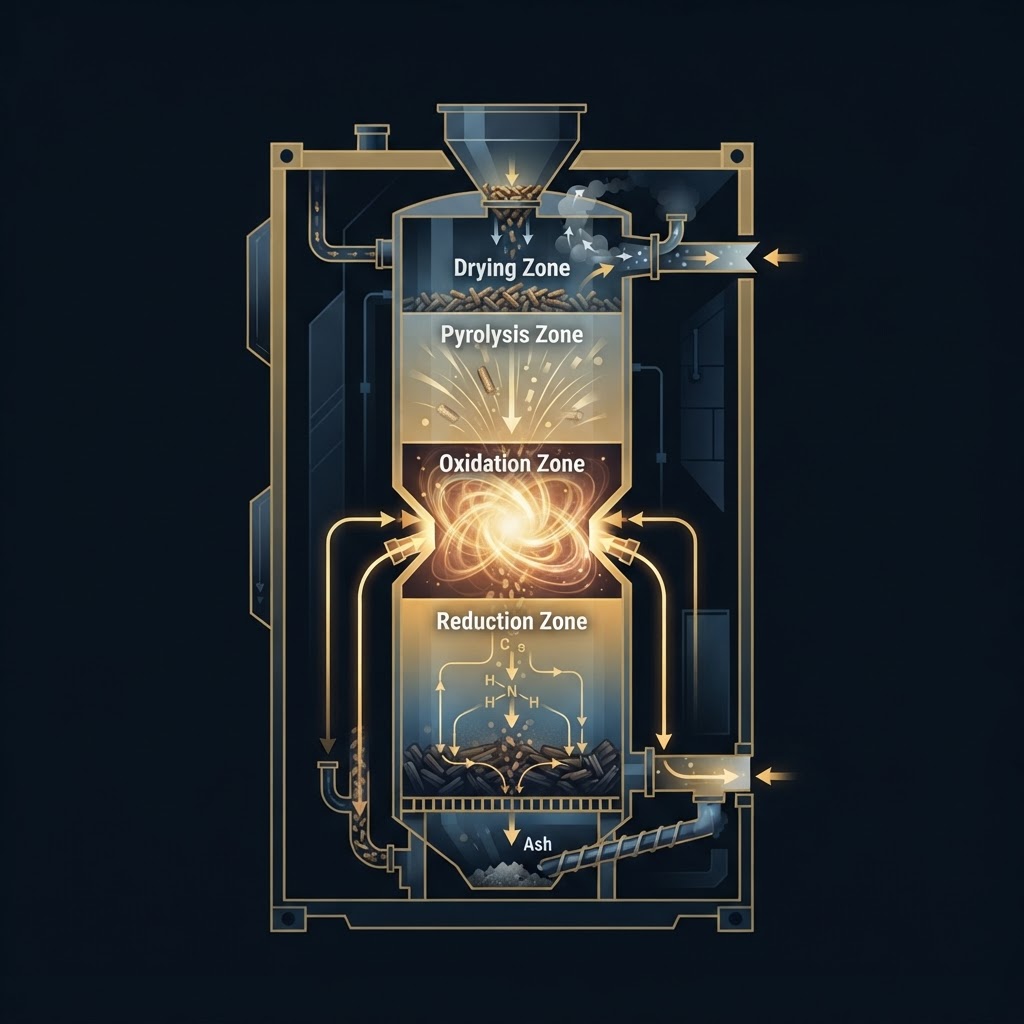
Waste gasification works by starving the fire on purpose. You heat waste to between 750 and 1100 degrees C with far less oxygen than it needs to burn, so it cannot finish burning. Instead of heat and flue gas, you get a combustible gas: carbon monoxide, hydrogen, some methane and carbon dioxide, called syngas. The process is a partial oxidation, and taken as a whole it is endothermic, meaning it needs heat put into it rather than giving heat off (Penn State EGEE 439).
That one sentence contains the commercial consequence that the rest of this page is about. A gasifier is not a furnace. It is a fuel factory. And a fuel factory is judged on the quality of the fuel it makes, which is why almost every gasification project that fails does so somewhere other than the reactor.
We build and license a 150 kg per hour gasifier, so this walkthrough attaches a real operating number to each stage rather than leaving you with a diagram.
Stage 1: feed preparation, where most projects are already lost
Every page explaining this process starts at the reactor. Start one step earlier, because this is the step that decides the rest.
The UK government's benchmarking review of advanced gasification technologies sets its design basis for municipal solid waste at 17.86% ash, 34.65% moisture and 0.96% chlorine, with a net calorific value of 9.70 MJ/kg. In the same report, a conventional downdraft gasifier is noted as unable to handle more than 20% moisture (BEIS, AECOM and Fichtner).
Read those two numbers together. Real municipal waste is roughly twice as wet as the machine most vendors quote for it.
Water is not a neutral passenger. Moisture above 25 to 30 wt% depresses the reactor temperature, and a depressed reactor makes tar (Oak Ridge review of thermochemical MSW conversion). Tar is the substance that shuts gasification plants down, so the failure chain runs from a sorting decision to a fouled engine three months later.
So feed preparation is not pre-work. It is part of the plant: sort, dry, size, densify. When our X-150 ran its longest documented campaign in Paris, the feedstock was 16,382 kg of digestate pellets, not digestate (Zero-X). The pellet is the engineering. The hardest version of this problem, sewage sludge gasification, is where ash content stops being a specification and becomes the whole design.
The four zones, and what each one is actually doing
Whatever the reactor geometry, the material passes through the same four stages: drying, pyrolysis, oxidation and reduction (Sustainability, 2025 MSW gasification review).
Drying
Surface and bound water is driven off, usually with waste heat recovered from further down the process. The product of this zone is steam and nothing else.
Cheap to describe, expensive to get wrong. Every kilogram of water you evaporate here is energy you do not sell, which is the second reason stage one matters.
Pyrolysis
Now the solid breaks down thermally, with no oxidant involved. Dry feedstock becomes volatiles plus char plus ash, and those volatiles split into tar and gas. The vapours come off at temperatures up to roughly 700 degrees C, and the solid residue left behind is char and ash.
This is where tar is born. Not at the outlet, here. Everything downstream is either destroying tar or living with it.
Oxidation
A deliberately limited amount of air, oxygen or steam is admitted, and part of the char and volatiles is burned.
This looks like a contradiction in a process defined by not burning things. It is not. Gasification is endothermic overall, so something has to pay the heat bill, and the cheapest option is to sacrifice a fraction of your own fuel. That is the trade at the centre of every air-blown gasifier: burn a little to convert a lot.
Reduction
The hot char now meets carbon dioxide and steam, and the actual syngas-forming chemistry runs: the Boudouard reaction, steam methane reforming and the water gas shift. Raising temperature from 700 to 900 degrees C drives H2 and CO up significantly. Push past 900 degrees C and hydrogen starts to fall again as competing reactions favour carbon monoxide.
Different designs place these zones differently, but the char conversion step is where the wide temperature bands come from, running anywhere between 760 and 1650 degrees C depending on the technology (Climate Technology Centre and Network). Which geometry you choose determines where tar ends up, and that comparison is its own article on types of gasifiers.
The one dial that decides the result
If you remember a single parameter from this page, make it the equivalence ratio: the air you actually supply divided by the air complete combustion would require.
For air-blown gasification the useful window is roughly 0.2 to 0.4, with steam to carbon held between 0.6 and 1.2 in steam or oxygen systems. Go too low and hydrogen rises but carbon conversion gets poor and tar climbs. Go too high and you slide toward combustion, which collapses the calorific value of the gas you were trying to make.
The window is narrow and the penalty on both sides is real. That is the honest reason gasification is harder to operate than incineration: an incinerator has one job and a wide margin, a gasifier has a setpoint.
What good tuning is worth shows up in measured data. In a modified downdraft gasifier running refuse-derived fuel pellets at an equivalence ratio of 0.4, preheating the inlet air from 100 to 210 degrees C moved carbon monoxide from 17.3% to 26.2%, hydrogen from 14.6% to 22.2%, the lower heating value from 4600 to 6053 kJ/kg, and carbon conversion efficiency from 85% to 93% (Sharma and Jain).
Same waste. Same reactor. A different air strategy, and a third more energy in the gas.
Air, oxygen or steam sets your product
The gasifying agent is chosen before anything else, because it decides what you are allowed to make.
Air is free and brings nitrogen with it, roughly four molecules for every one of oxygen. That nitrogen does no work, dilutes the product and leaves you with a low-Btu gas at about 4 to 6 MJ/Nm3. Pure oxygen removes the ballast and yields a mixture of carbon monoxide and hydrogen with virtually no nitrogen, at the cost of running an oxygen supply. Steam gasification is effectively reforming, and pushes the gas toward hydrogen, lifting heating value into the 8 to 12 MJ/m3 range.
The practical rule: if you want megawatts, air is defensible. If you want molecules, nitrogen is a tax you cannot afford to pay, because every downstream synthesis step would have to carry it.
Our own oxy-steam configuration runs with zero nitrogen ballast and reached 33% hydrogen in the syngas at an H2/CO ratio of 1.95:1 during that Paris campaign. That ratio is not a vanity metric. It is the number that decides whether methanol or Fischer-Tropsch synthesis is even available to you. The full picture of what ends up in the gas is covered in syngas composition.
What comes out, and the part everyone underprices
Three streams leave a gasifier, and only one of them is the product.
Syngas, with a heating value between 4000 and 12000 kJ/kg depending on feedstock and agent. Note that its energy density sits up to 30% below natural gas, which is why syngas is generally used where it is made rather than injected into a gas grid.
Char and ash, carrying the non-volatile minerals. In a carbon-rich form this is biochar, which is a saleable output rather than a disposal cost.
Contaminants, and this is the stream that decides whether your plant runs. The raw gas carries particulate matter, tar, alkali metals, chlorine and sulfide, in proportions set by how good your feedstock was.
Here is the thing the industry underprices, repeatedly. The gas cleaning is the project. It is not an accessory bolted onto a reactor. Price it as an accessory and the plant either misses its guarantees or spends its life shut down for cleaning.
We treat ours as a product in its own right for that reason. SyngaPure removes 99% of tar compounds while maintaining energy efficiency (Zero-X), using real-time sensing of tar, H2S, NH3 and particulates with AI-supported control, and it was selected for German federal BMWK go-inno support in December 2025 (Zero-X). Across the 1,939 hour continuous Paris campaign the system held 99.98% tar conversion, and what that figure actually takes is a longer story than a filter.
What the syngas is for
Cleaned syngas has four destinations, in ascending order of how clean it must be.
Burn it in a boiler for steam and power, which is the classic route and the most forgiving. Run it in a gas engine or turbine for combined heat and power, which needs the tar gone. Shift and purify it to hydrogen. Or synthesise it into methanol, Fischer-Tropsch fuels or aviation fuel, which is where a flame simply cannot compete, because combustion produces heat and gasification produces a chemical feedstock.
That last route is the entire strategic argument for gasification, and it is unavailable to you if you chose air at the top of the process. For the head-to-head on efficiency, emissions and track record, see gasification vs incineration; for why the sub-megawatt class behaves differently from municipal scale, see small scale waste to energy systems.
Why plants that draw this diagram correctly still fail
The chemistry above is roughly two hundred years old and not in dispute. Commercial waste gasification is still early stage, and it is worth being blunt about how early: the UK benchmarking review found that none of the advanced gasification technologies it assessed were in commercial operation, with technology readiness levels between 6 and 8.
Vendor explainers do not help. The best-known one describes a single proprietary oxygen-blown process running at around 2200 degrees C with molten inorganics tapped off as vitrified stone (Sierra Energy). It is a clear description of that machine, presented as though it were gasification in general, with no operating data attached.
The gap between the diagram and a working plant is almost never chemistry. It is three things: feedstock variance the design never anticipated, tar priced as a component instead of a system, and availability, which is the number nobody publishes.
So when someone shows you this diagram, ask three questions.
- What continuous-hours figure can you show on my feedstock, unbroken, feedstock named? Annual availability on clean wood tells you nothing about your sludge in March. Ours is 1,939 hours on digestate pellets, and the X-150 has been independently validated at Paris COMETHA, at Verkoso with Fraunhofer IKTS and at Hochschule Zittau/Goerlitz on high-ash sludge, MSW and digestate (Zero-X).
- What ash, moisture and chlorine does your quoted performance assume? Not the national average. Mine.
- Who owns the gas cleaning? If the answer is a third party quoted later, the project has a hole in it.
Everything else on the diagram is settled science.
FAQ
What temperature does waste gasification need? Around 750 to 1100 degrees C overall, though the char conversion step spans a much wider band, from about 760 up to 1650 degrees C depending on the technology. The practical constraint is narrower than the range suggests: run too cool and tar production climbs, run above 900 degrees C and the hydrogen fraction starts falling as carbon monoxide is favoured.
Can you gasify unsorted household waste directly? Not into a fixed-bed machine. Published municipal waste sits around 34.65% moisture against a downdraft limit near 20%, so sorting, drying and densification are capital items inside the plant, not optional preparation. Fluidised bed designs tolerate more heterogeneity, which is why they dominate above about 10 MW.
Is waste gasification the same as pyrolysis? No, and the relationship is worth getting right: pyrolysis is one stage inside gasification. Pyrolysis alone stops once the volatiles are off, leaving char, tar and gas to be handled separately. Gasification adds a controlled oxidant so that char and tar are converted onward into syngas instead of becoming products you have to sell.
Does gasification produce dioxins? The oxygen-starved, reducing atmosphere suppresses dioxin and furan formation at source, and they are generally destroyed in the process. That is a genuine mechanism advantage rather than a marketing claim. It is not a permit shortcut, because the raw gas still carries chlorine and sulphur species that the cleaning train has to remove before any engine, turbine or synthesis catalyst will accept it.
How much waste does a gasifier need to be worth building? There is no universal threshold, but the shape of the answer is that fixed-bed designs are documented as suitable for small and medium scale while fluidised beds are preferred above roughly 10 MW. Below the megawatt line the economics stop depending on electricity alone and start depending on gate fees, heat, char and avoided disposal cost.
We use cookies to improve your experience on this site. By continuing, you agree to our Privacy Notice.