develoPPP Funding for Waste to Energy: Applicant's Guide
Every page that ranks for develoPPP funding is written by the funder. The programme site, DEG Impulse, GIZ, a chamber of commerce. They tell you what the programme offers. None of them tells you whether a waste to energy project fits, who in a technology partnership should be the applicant, or what "up to 50 percent" does to your cash plan.
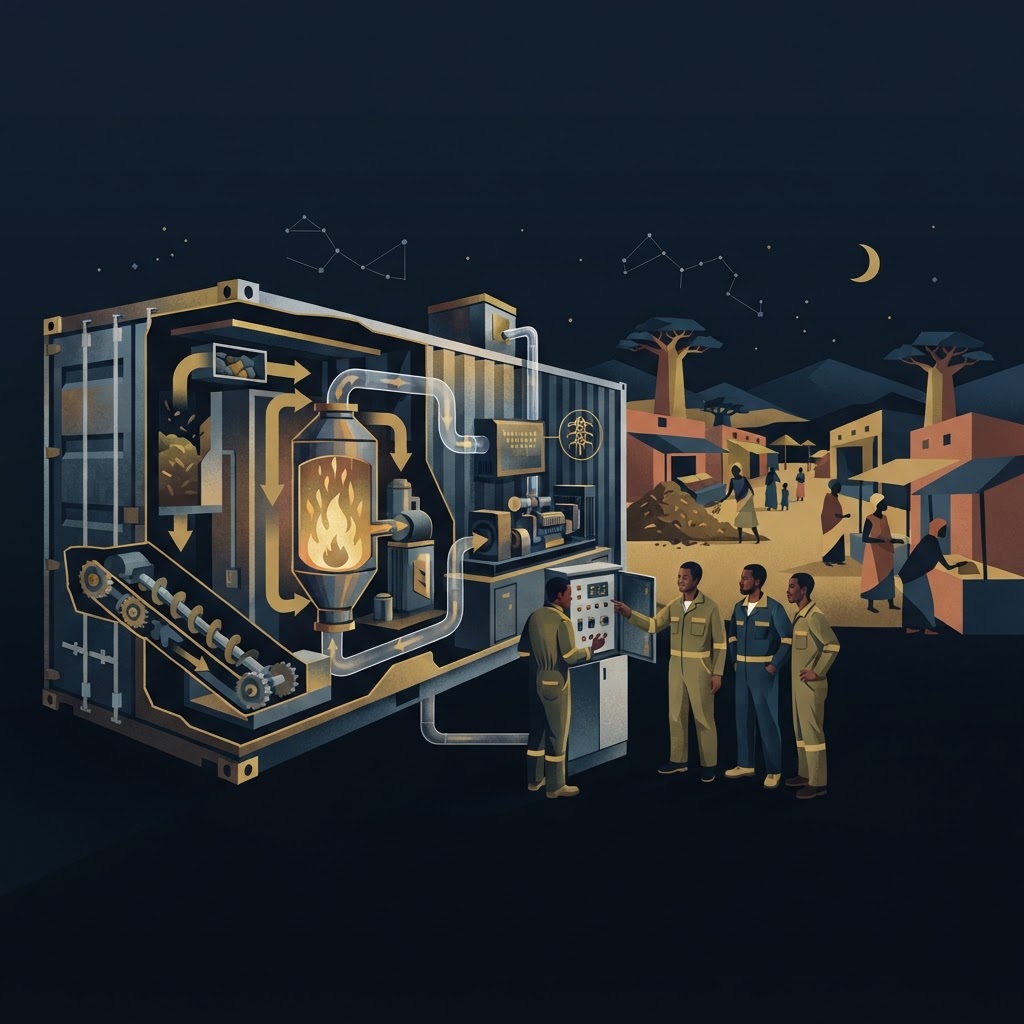
This guide is written from the other side of the table. We license a containerised 150 kg/h gasification platform to developers in emerging markets, so the question we hear is never "what is develoPPP". It is "can it pay for our first plant, and how". Here is the honest answer, with every number tied to the programme's own pages. For the wider funding map across the EU and national schemes, start with our guide to government grants for waste to energy.
What develoPPP funding is, in one paragraph
develoPPP is a programme of the German Federal Ministry for Economic Cooperation and Development (BMZ). It co-finances private projects in developing and emerging countries that combine a long-term business interest with a development benefit measured against the UN Sustainable Development Goals (develoPPP). Two public partners run it on the BMZ's behalf, DEG Impulse and GIZ, and it comes as two instruments: Classic for established companies and Ventures for young companies already operating in the target market. Since 1999 the programme has carried out more than 2,800 partnerships with German and European business (IHK Rhein-Neckar).
Classic or Ventures: which one a waste to energy company fits
The two instruments look like siblings. For an energy hardware company they are almost opposites.
develoPPP Classic: up to EUR 2 million, half paid by you
Classic funds projects with between EUR 100,000 and EUR 2 million of public money, covering up to 50% of total expenditure, in more than 60 developing and emerging countries (develoPPP Classic). The project types it names are broad: training local experts, piloting innovative technologies and demonstration plants, building sustainable supply chains, raising environmental and social standards.
That list matters for waste to energy. A first containerised plant in a new country is, in the programme's own vocabulary, a demonstration plant with a training programme attached. That is the shape a fundable project takes.
develoPPP Ventures: EUR 100,000 for African start-ups already selling
Ventures provides EUR 100,000 of non-dilutive capital, with potential top-up, through a matching-funds model: you must raise at least the same amount from other investors (develoPPP Ventures). It is available in Côte d'Ivoire, Ghana, Kenya, Nigeria, Rwanda, South Africa and Tanzania. The company must have finished its start-up phase, have revenue, have raised no more than EUR 2 million to date, and expect break-even within three years.
The waste sector does appear in the portfolio. Biobuu Tanzania, an organic waste collector and processor making insect protein and compost, received EUR 300,000 in public funding with DEG Impulse from February 2023 (develoPPP portfolio).
The catch for gasification: Ventures funds a growth investment by a locally registered company, and the contract can only be signed with that local entity (Ventures call). It also excludes markets where an established market with competitors already exists. A Nigerian waste operator scaling a service business can fit. A European licensor cannot apply, and EUR 100,000 does not move the needle on a thermal plant.
Rule of thumb: a European or OECD-DAC company bringing technology into a country belongs in Classic. A local operator with revenue and an investor lined up may belong in Ventures. Many projects need both, at different stages.
The eligibility screen, and why most technology licensors fail it alone
Classic is open to companies registered in the EU, an EFTA country or an OECD-DAC country. Then comes the screen. Your company must have at least eight employees, an annual turnover of at least EUR 800,000, at least two audited annual financial statements, and a positive net income with enough equity and liquidity to fund its contribution.
Read that list as a deep-tech founder and it hurts. A young technology company with a working machine and a thin balance sheet usually fails at least one line. We are an example ourselves: Zero-X lists eight employees and was founded in 2020 (Zero-X on LinkedIn). Strong on engineering data, not the profile a size screen is built for.
There is a door for this. If your company does not meet the criteria but your business partner in an eligible country does, you can submit a joint project proposal. In a licensing model this is the natural shape anyway. The established developer, waste group or industrial company that holds the territory is the applicant with the audited accounts. The licensor is the technology partner that makes the project credible. This is exactly how we structure partnerships: the partner owns the market and the project, we bring the machine, the German supply chain and the grant playbook (Zero-X partners). If that model is new to you, see how waste to energy technology licensing splits the roles.
What the 50 percent rule means in cash
"Up to 50%" is a ceiling on the public share, and the company's side is a floor: your company carries at least half of the total cost. The arithmetic is simple and unforgiving:
| Public funding requested | Minimum company contribution | Minimum total project |
|---|---|---|
| EUR 100,000 (floor) | EUR 100,000 | EUR 200,000 |
| EUR 1,000,000 | EUR 1,000,000 | EUR 2,000,000 |
| EUR 2,000,000 (ceiling) | EUR 2,000,000 | EUR 4,000,000 |
Three things change the real number.
- The project is not your whole plant. develoPPP funds the development-relevant project around your business, not your core investment. The measures must go beyond investing in your core business. Expect the commercial plant and the develoPPP project to be two budgets that overlap, not one.
- Subsidiarity. Funding is only possible if you would not carry out the idea without the public partner. Legally required measures cannot be financed, and projects already running cannot be funded after the fact unless they add new development-relevant elements.
- Liquidity is tested up front. Positive net income and enough equity to cover your share are entry conditions, not something to solve after approval.
For sizing the plant itself, start from what a waste-to-energy plant costs to build, then decide which slice of the programme around it is develoPPP-shaped.
What a fundable waste to energy project looks like
Development benefit is the scoring axis, not the machine
Committees do not fund gasifiers. They fund what changes for people locally: trained technicians, waste that stops being dumped or burned, power where the grid is weak, a supply chain that stays when the funder leaves. Technology is the means. Write the application that way round.
A strong waste to energy project for develoPPP Classic typically combines:
- A demonstration unit in a real setting (a market, an agro-processor, a landfill site), with data published locally.
- A training programme that certifies local operators and service technicians, so the second and third units do not need flights from Europe.
- A feedstock and offtake model with local partners, which shows the long-term business interest the programme requires.
- Measured outcomes: tonnes diverted, hours of power, people trained.
This is where verifiable operating data earns its keep. A reviewer can check that our X-150 ran 1,939 hours continuously in the COMETHA campaign in Paris, processing 16,382 kg of digestate pellets with 33% hydrogen in the syngas (Zero-X), and that our SyngaPure gas cleaning system was selected for German federal go-inno support in December 2025 (Zero-X). Whatever technology you bring, "piloting innovative technologies" scores better when the technology has already run somewhere independent of the applicant.
Two energy and waste precedents
Biogas in the Philippines. German biogas tank maker Lipp ran a three-year develoPPP project, "Pineapples to Power", to train Filipino technicians in building, maintaining and safely handling biogas plants. It was 50% co-financed by DEG with BMZ funds, around two industrial plants built for a pineapple producer (AHK Philippines). Note the structure: the plant was a commercial build-own-transfer deal, and the develoPPP project was the skills layer around it.
Organic waste in Ghana. In "Waterweed to Value", GIZ and Volta River Estates turn waterweed into compost, aiming to scale from about 3,000 to 16,000 tonnes per year, with 5,000 tonnes a year supplied to smallholder farmers (GIZ Ghana). A waste stream, a local business, a measurable community benefit. That is the pattern.
For a gasification project in Africa the same logic applies: the plant replaces diesel or dumping, the project builds the people and the data. Our notes on off-grid power solutions and waste to energy in Africa cover the site side.
DEG Impulse or GIZ
You pick the implementing partner when you apply, and the choice is not cosmetic. DEG Impulse focuses on projects the company implements on site largely on its own. GIZ focuses on projects that need on-site technical support and integration into local networks. Each has implemented more than 1,000 projects with companies (develoPPP Classic competition).
For a first waste to energy unit in a new country, the question is who handles the local layer. If your partner already has permits, feedstock contracts and a government relationship, DEG Impulse fits. If the project needs municipal waste agreements, ministry contacts or community engagement you do not yet have, GIZ's network is the reason to choose it. If unsure, the programme's contact persons will advise before you submit (develoPPP platform).
A realistic develoPPP timeline
Classic runs as an ideas competition twice a year, six weeks each: 15 February to 31 March and 15 August to 30 September. The autumn 2026 window has closed, and the next Classic call opens on 15 February. The next Ventures call opens on 15 November.
After a window closes:
- Initial assessment: your implementing partner tells you within about six weeks whether the idea can be pursued.
- Detailed concept: developed with DEG Impulse or GIZ; how long depends on how mature your idea is.
- Second assessment and contract: usually up to four weeks.
The programme itself says to plan for roughly six months from application to project start. Working backwards for a February submission, that means partner agreement, feedstock letters and two audited statements ready in January, and a project start around late summer. Applications go through the central platform, where drafts can be saved and edited until the deadline.
Where develoPPP sits in the capital stack
develoPPP is a precise tool, not a financing plan. At a maximum of EUR 2 million public money against an equal private share, it pays for the development layer of a reference project: the demonstration, the training, the local supply chain. It does not finance a fleet.
The projects that work use it for what it is good at. A reference unit and a certified local team, documented well enough that the next units can be financed by EU, national or development-bank routes and by project finance. That sequence, one grant-funded reference project then rollout, is the core of our partner model. The other routes are mapped in our upcoming guide to waste to energy funding opportunities.
If you hold a territory in Africa or another emerging market and are weighing a develoPPP application around a first gasification unit, talk to us before the February window. The best applications are written months before the portal opens.
FAQ
Can a company outside Germany apply for develoPPP funding?
Yes. Classic is open to companies registered in any EU member state, an EFTA country or an OECD-DAC country. Ventures works the other way round: the start-up must be registered in the target country, or register there before the funding starts.
Is develoPPP a loan or a grant?
Neither instrument is described as a loan. Classic is public co-financing of up to 50% of a joint project, with the company carrying the rest. Ventures provides non-dilutive capital, so the BMZ takes no equity, matched by at least the same amount from other investors.
Can develoPPP fund a project that has already started?
In principle no. Running projects cannot be co-financed after the fact unless they add new development-relevant elements. Apply before you commit to the activities you want funded.
Where do I submit a develoPPP application?
Through the central develoPPP application platform, for both Classic and Ventures. Ventures applicants active in Kenya, Tanzania or Rwanda use the VC4A platform instead.
We use cookies to improve your experience on this site. By continuing, you agree to our Privacy Notice.