Biochar Production Cost per Ton: What the Studies Show
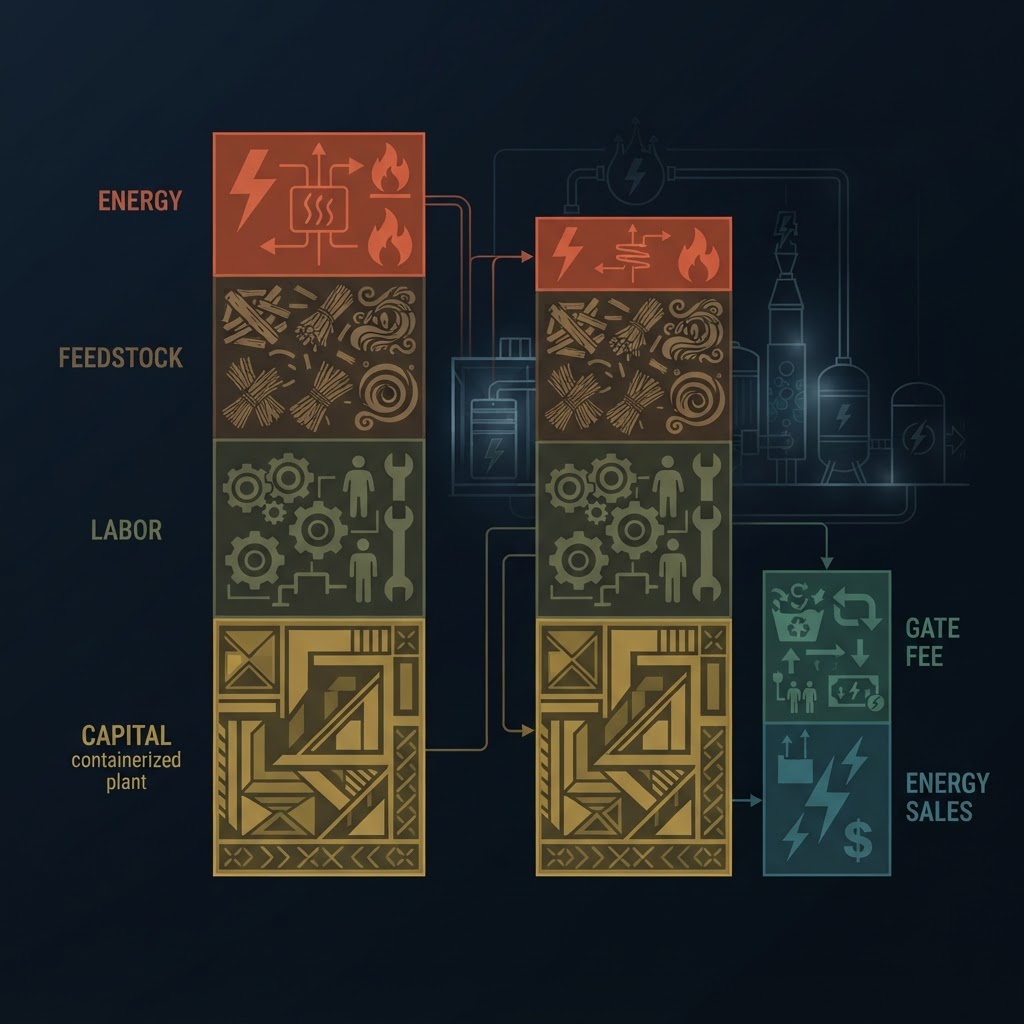
Ask five studies for the biochar production cost per ton and you get five answers that do not overlap. A global techno-economic model from RWTH Aachen puts it anywhere between EUR 113 and EUR 1,549 per ton. A US Forest Service study of portable kilns lands at $3,000 to $5,000 per tonne for one system. A refinery-scale model says under $200.
None of these numbers is wrong. Each one is the answer for a specific machine, at a specific scale, running a specific number of days, on a specific feedstock. This guide lines them up, breaks a tonne of biochar into the four things you actually pay for, and then shows the lever most studies leave out: feedstock that pays you to take it, and a machine whose energy output carries the capital.
The short answer: it depends on four variables
Here is what the main recent studies found, side by side.
| Study | Setup | Cost per tonne of biochar |
|---|---|---|
| RWTH Aachen, global model | Kon-Tiki kiln vs 100,000 t/yr Pyreg plant | EUR 113 to EUR 1,549 |
| USDA Forest Service | Portable systems, 100 working days | $580 to $5,000 |
| US slow pyrolysis TEA | 2,000 dry t/day plant | $188 to $260 |
| University of Leeds farm | 300 t/yr on-farm system | about GBP 754 |
| Elias et al. 2024 | Market review | $200 to $1,000 in 2015, trending toward $200 |
The spread is not noise. Read the table again and four variables explain almost all of it: how much capital sits behind each tonne, how many days a year the machine runs, what the feedstock costs, and whether you buy or sell energy. Change any one of them and the number moves by a multiple, not a percentage.
Where the money goes in a tonne of biochar
Capital
The University of Leeds team designed an integrated on-farm system that turns straw and manure into 300 t of biochar a year at about GBP 754 per tonne. When they decomposed the cost, annualised capital was the single biggest block at 38%, operating costs 32% and electricity 30%.
Capital cost per tonne is simple arithmetic: the annualised cost of the machine divided by the tonnes it produces. That is why small, expensive machines look terrible on this metric and why the biochar production equipment you choose matters less than how hard you run it.
Labor and operating days
The USDA portable-systems study shows this more clearly than any other source. At 100 working days a year, the minimum selling price was $3,000 to $5,000 per tonne for the Biochar Solutions system, $1,600 for the Oregon Kiln and $580 for an air curtain burner. Let the improved Biochar Solutions system run all year and the same study brings it below $1,000 per tonne.
Same machine, same feedstock, a different calendar, and the cost per tonne drops by a factor of three or more. Utilisation is the most underrated number in biochar economics.
Feedstock
At scale, feedstock takes over. In a US techno-economic analysis of a 2,000 dry tonne per day slow pyrolysis plant, feedstock was the largest operating cost, with woody biomass and corn stover delivered at $81 and $87 per ton and food waste at $50. The plant's total capital investment was $128 million, and the resulting minimum selling price was $198 per tonne for woody biomass, $188 for corn stover and $260 for food waste.
That last line surprises people. Food waste was the cheapest input and still produced the most expensive char, because it yields less biochar per tonne fed. Cheap feedstock does not guarantee cheap biochar. Yield matters as much as price.
Energy
Pyrolysis and gasification need heat to start and power to run conveyors, dryers and controls. In the Leeds system, electricity was 30% of the cost of every tonne of CO2 abated. Whether a plant is a net buyer or a net seller of energy is often the difference between a cost line and a revenue line, and most per-tonne studies assume buyer.
Scale and region change the number more than technology
The RWTH model is the most useful single dataset because it compares two technologies across nine world regions. Median production costs per ton:
| Region | Kon-Tiki flame curtain kiln | Pyreg plant (100,000 t/yr) |
|---|---|---|
| Sub-Saharan Africa | EUR 198 | EUR 290 |
| South Asia | EUR 211 | EUR 287 |
| Europe | EUR 548 | EUR 498 |
| North America | EUR 881 | EUR 631 |
The pattern is clean. Where labor and biomass are cheap, a hand-fed kiln wins. Where labor is expensive, the automated plant wins, and the authors note it becomes more competitive again when its heat can feed a district heating network. The technology is not cheap or expensive in itself; the region's labor cost decides which one is.
The refinery-scale figures of $188 to $260 per tonne mark the practical floor for purpose-built biochar. They sit inside the reported market range of $91 to $350 per tonne for char sold as a material, which tells you how thin the margin is if char is the only product.
What a tonne of biochar sells for
Cost only means something next to revenue, and biochar has two revenue lines: the material and the carbon removal.
On the material side, the market range above ($91 to $350 per tonne) is the realistic band for bulk char.
On the removal side, each tonne of biochar typically represents about 1.9 to 2.7 t of CO2 depending on methodology, so one tonne of char can carry two or more removal credits. Prices for those credits are a market in their own right. Biochar removal averaged $165 per tonne of CO2 in 2024, within a $113 to $310 range, with high-quality projects at $226 against $158 for low quality. By October 2025, S&P Global data put US biochar credits at around $150 per tonne of CO2e.
Credit revenue depends on certification, monitoring and buyers, which is a discipline of its own; current biochar carbon credit price per ton benchmarks go deeper on that side. For production economics the takeaway is this: at today's prices, credit revenue per tonne of char can exceed the char's material value, and the Elias team expects carbon markets to become the primary revenue source, turning biochar into a secondary product. For the full revenue picture, see is biochar production profitable.
The lever most studies skip: a feedstock that pays you
Almost every cost study above assumes you buy biomass. That single assumption hides the largest swing factor available to a real project.
Gate fees instead of feedstock bills
The Elias analysis gives a glimpse of what happens when the assumption flips. Disposing of forest slash by pile burning already costs money, so land managers could effectively subsidise mobile biochar production by $150 to $300 per tonne of biochar and still come out ahead. In that study's breakeven tables, the feedstock price at which mobile production still makes its target return goes negative: the producer has to be paid to take the biomass.
That is the normal state of affairs for waste. Sewage sludge, digestate, municipal solid waste and agricultural residues carry a disposal cost for whoever owns them. A plant that accepts them collects a gate fee instead of paying a feedstock bill, and feedstock moves from the biggest cost line to a revenue line. The economics of biochar from sewage sludge are the clearest European example, driven by phosphorus recovery mandates.
Energy carries the capital
The second flip is energy. A pyrolysis kiln built to maximise char sells char. A gasifier built to convert waste sells syngas, power, heat or hydrogen, and produces biochar alongside. In that model, the cost of the machine is carried by the energy and disposal revenue, and the char is not the line the capital has to be recovered from.
This is a different answer to the question "what does a tonne cost", and it is why per-tonne numbers from purpose-built pyrolysis plants do not transfer to waste-to-energy sites. If you are pricing a whole installation rather than a tonne, the planned guide to biochar production plant cost covers the capital side.
What continuous operation on real waste looks like
Utilisation and feedstock flexibility only help if the machine actually runs on waste for months, not hours. The Zero-X X-150, a 150 kg/h containerised fixed-bed downdraft gasifier, ran a 1,939-hour continuous campaign in Paris under the COMETHA project: 80 consecutive days, 16,382 kg of digestate pellets processed, 33% hydrogen in the syngas and 99.98% tar conversion.
The platform has been independently validated at COMETHA, at Verkoso (Fraunhofer IKTS) and at Hochschule Zittau/Goerlitz, on high-ash sludge, MSW and digestate, the feedstocks most clean-wood systems cannot handle. In Zero-X's target markets, governments fund 56 to 70% of project capital, which attacks the 38% capital block from the Leeds breakdown directly. The routes are covered in our guide to grants for biochar production.
We do not publish a Zero-X cost per tonne of biochar, because on a waste-to-energy site that number is an accounting choice about how to split shared costs between energy, disposal and char. What we can say is which variables move it, and in which direction.
How to build your own cost-per-ton estimate
Use the studies above as sanity checks, then build the number for your own site from five lines:
- Capital per tonne. Annualised capital (after any grant) divided by realistic annual tonnes of char. Use real operating days, not nameplate.
- Labor per tonne. Crew cost per operating day divided by tonnes per day. Hand-fed kilns are labor-heavy; continuous plants are capital-heavy.
- Feedstock, net. Purchase and haulage cost minus any gate fee. On waste, this line can be negative.
- Energy, net. Electricity and fuel bought minus power, heat or gas sold.
- Revenue offsets. Char sales plus removal credits, priced conservatively and only after certification is realistic.
If lines 3 and 4 are both costs, expect results in the ranges the studies show. If either becomes revenue, you are running a different business, and the per-tonne cost of the char stops being the number that decides the project.
FAQ
What is the cheapest way to produce biochar per ton?
In low-wage regions, a Kon-Tiki flame curtain kiln. The RWTH global model found median costs of about EUR 198 per ton in Sub-Saharan Africa and EUR 211 in South Asia. In Europe and North America, automated plants become cheaper than kilns because labor dominates.
How many carbon credits does one tonne of biochar generate?
Roughly 1.9 to 2.7 t of CO2 removal per tonne of biochar, depending on the methodology used. Market models commonly assume 2.3 to 2.5 t.
Why are portable biochar systems so expensive per ton?
Mostly low utilisation. Run for only 100 days a year, portable systems in the USDA study cost $580 to $5,000 per tonne. Running the improved Biochar Solutions system year-round brought it below $1,000.
Does biochar from food waste cost more than biochar from wood?
In one large US techno-economic analysis, yes: $260 per tonne from food waste versus $198 from woody biomass, even though food waste was the cheapest feedstock, because it yields less char.
Available for advisory work, board seats and media appearances.
Julien Uhlig advises boards and funds and briefs newsrooms across Europe and North America. Enquiries are read personally.
We use cookies to improve your experience on this site. By continuing, you agree to our Privacy Notice.