Waste to Hydrogen Plant: 6 Projects, One Honest Ratio
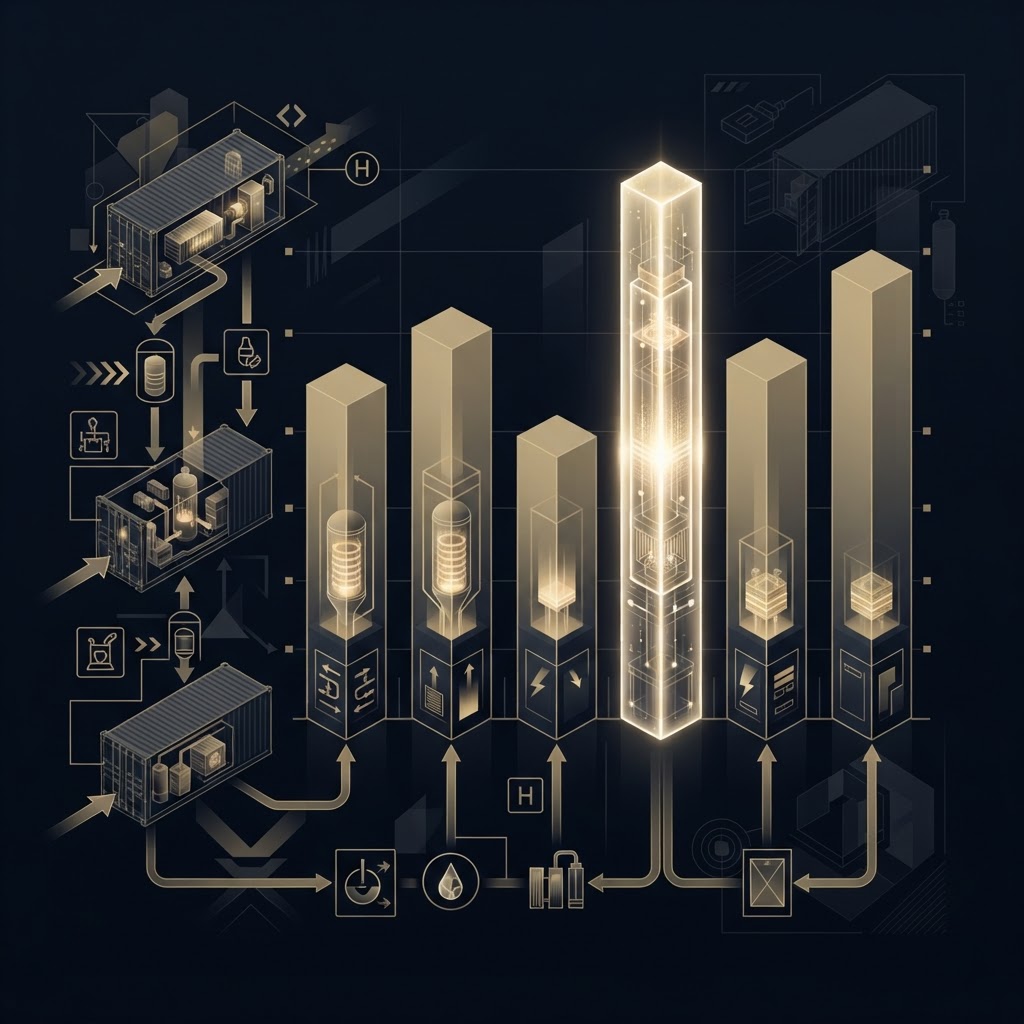
Every waste to hydrogen plant announcement reports two numbers in its own units: tonnes of waste in, and hydrogen out per day, per year, or per "line". Put them side by side and divide, and you get the one figure that separates a plant from a press release: kilograms of hydrogen per tonne of waste. Across six published projects that ratio runs from about 2 to about 170. It cannot all be true in the same physics, and the spread tells you where to push.
We build and run gasifiers, so we have a bias. The table below uses only each developer's own published figures. The ratio is arithmetic on those figures, not our estimate.
What a waste to hydrogen plant actually is
Strip the renderings away and every plant has four blocks: a front end that turns mixed waste into a consistent feed, a converter that turns it into a hydrogen-bearing gas, a gas cleaning train, and a shift and purification stage that turns that gas into hydrogen a customer will accept. We walk through each in the four stages of a waste to hydrogen chain.
The converter comes in two families:
- Biological. Anaerobic digestion makes biogas, which is reformed to hydrogen. Mature, wet-feed friendly, low hydrogen per tonne.
- Thermal. Gasification or plasma gasification breaks the waste into syngas. For municipal solid waste, a 2026 review puts gasification at 800 to 1,100 C, yielding syngas at 39 to 51 percent hydrogen by volume. Higher yield per tonne, and much harder gas cleaning.
Which family a plant uses decides which ratio is plausible. If you want the chemistry of that gas, start with what is actually in the gas.
Six plants side by side
| Plant | Route | Waste in | Hydrogen out | Status | kg H2 per t waste |
|---|---|---|---|---|---|
| Hyundai HTWO, Cheongju, KR | Digestion, biogas reforming | 100,000+ t/yr organic | about 500 kg/day | Operating since May 2026 | about 2 |
| Raven SR, Richmond, US | Thermal | 99 wet t/day | about 2,400 t/yr | Permitted, launch 2027 | about 66 |
| Pune, IN | Plasma gasification of RDF | 350 t/day MSW | 9 t | Awarded 2023 | about 26 |
| SGH2, Lancaster, US | Thermal | 40,000 t/yr paper | 12,000 kg/day | Permitted, not built | about 110 |
| Manston, UK (press) | Plasma gasification | 44,000 t/yr | 7,600 t/yr | Planning application | about 173 |
| BEEAH and Chinook, Sharjah, AE | Thermal | not disclosed | 7 t/day, phase one | Commissioning Q2 2027 | cannot compute |
Sources, row by row. Cheongju produces roughly 500 kilograms of hydrogen a day from wastewater sludge biogas, with a target of two tonnes a day by 2030, and began commercial production in May 2026 at 99.97 percent purity on more than 100,000 tonnes of organic waste a year. Raven SR will process up to 99 wet tons of organic waste a day into about 2,400 metric tonnes of hydrogen a year, at roughly 75 million dollars, launching in 2027. Pune will take 350 tonnes of municipal waste a day, make 150 tonnes of RDF and generate 9 tonnes of hydrogen by plasma gasification under a 30-year concession; the article writes the unit as "9MT" without a time base, so we read it as daily and flag that. SGH2 designs for 12,000 kilograms a day from 40,000 tonnes a year of mixed paper waste. BEEAH plans 7 tonnes a day in phase one on technology assessed at TRL 6 to 7, with no feedstock tonnage published, so its ratio stays blank rather than guessed.
Only one row is operating, and it has the lowest ratio. That is not a coincidence.
The ratio that sorts announcements from plants
The digestion row is low because digestion only converts the biodegradable fraction, and wet organic waste is mostly water. Cheongju is not underperforming. It is honest about a route that trades yield for maturity, and it has a customer and a purity spec to show for it.
The thermal rows are where you need to read closely. Raven SR at about 66 kg per wet tonne and Pune at about 26 kg per tonne of raw MSW sit in a range a thermal plant with a real front end can argue for. SGH2 at about 110 kg per tonne is on dry paper, the easiest feed there is, and still an unbuilt design. Manston's press figure of about 173 kg per tonne means roughly 17 percent of the incoming waste mass leaves as pure hydrogen. That is the number to question first.
Three rules for using the ratio:
- Ask "per tonne as received". Wet tonnes, dry tonnes and tonnes of RDF are three different denominators. Pune's 9 tonnes is about 26 kg per tonne of MSW, or about 60 kg per tonne of RDF.
- Ask whether it was measured or designed. Five of the six rows are design figures.
- Ask what else leaves the plant. Carbon has to go somewhere. A plant that claims high hydrogen and high CO2 output from the same tonne should show the mass balance.
Manston, read closely
Manston is the project most searchers find first, so it deserves the careful read. The planning application was submitted in April 2026 for a plant processing 44,000 tonnes of non-recyclable waste a year. Local coverage adds a 120 million pound scheme producing 7,600 tonnes of fuel cell grade hydrogen and 110,000 tonnes of liquid CO2 in its first trading year.
The developer's own EIA scoping report describes two processing lines of at least 22,000 tonnes each, about 170 tonnes of waste a day, each line with "an output of 4 tonnes of hydrogen annually", using a process "known as Plagazi" at upwards of 3,000 C. Eight tonnes a year and 7,600 tonnes a year differ by a factor of 950. One of them is a typo. A planning authority should know which before it rules.
Then the technology. Swedish local press reports Plagazi in bankruptcy in Koping. That does not sink Manston by itself; licences outlive licensors, and teams move. It does mean the technology question is now "who supports this reactor for 25 years", and the application should answer it.
None of this is an attack on the project. It is the diligence any waste to hydrogen plant should survive, including ours.
Size is the first design decision
Most plants in the table are big because the classic rule says they must be. India's waste-to-energy task force held that plants are viable only at 300 tonnes a day or more, which restricts them to cities above 2 million people. Big plants mean big permits, long timelines and one feedstock contract that can sink everything.
The other design is modular: a plant built from containerised units, sized to one waste stream. That is the route we took with the X-150, a 150 kg/h gasifier. Our reference is a measured run, not a design sheet: the X-150 ran 1,939 consecutive hours in the COMETHA project in Paris, processed 16,382 kg of digestate pellets and delivered 33 percent hydrogen in the syngas at an H2/CO ratio of 1.95:1 in oxy-steam mode. Note what that figure is: hydrogen share of the syngas, not kg of purified hydrogen per tonne. We do not publish a kg per tonne number until a full purification campaign has measured it, and you should hold every developer, us included, to that line.
Gas cleaning is the stage that decides whether the syngas ever becomes hydrogen. Our SyngaPure train removes 99 percent of tar compounds, and the platform is validated on high-ash sludge, MSW and digestate, with public grants funding 56 to 70 percent of project CAPEX in our Wave 1 markets. For how operators and developers stack up on evidence, see waste to hydrogen companies sorted by evidence; for the municipal feed specifically, municipal solid waste to hydrogen.
Five numbers to ask any plant developer for
- Kilograms of purified hydrogen per tonne of waste as received, with the moisture basis stated.
- Continuous run hours on the actual feedstock, not on clean wood or pellets from a different stream.
- Delivered purity and the offtaker's spec. Fuel cell grade and industrial grade are different plants.
- Gas cleaning performance: tar, H2S and NH3 after the train, measured.
- The mass balance: where the carbon, ash and water go, in tonnes.
A developer who can hand over all five has a plant. One who can hand over only a rendering and a jobs number has a planning application.
FAQ
How much hydrogen does a tonne of waste produce?
It depends on the route and the feed. Published plants imply about 2 kg per tonne for biogas from digestion up to about 110 kg per tonne for a dry paper gasification design. Claims far above that deserve a mass balance before belief.
How much does a waste to hydrogen plant cost?
Published figures are about 75 million dollars for Raven SR at 99 wet tonnes a day and 120 million pounds for Manston. In some EU regions public grants can cover over half of project CAPEX, which changes the economics more than the reactor choice does.
What is the minimum size for a waste to hydrogen plant?
Classic waste-to-energy planning in India set 300 tonnes a day as the viability floor. Modular gasifiers invert that logic, starting from a single 150 kg/h unit matched to one waste stream.
Is there a waste to hydrogen plant operating in the UK?
Not yet. Manston in Kent is at planning application stage as of April 2026 and would be the first commercial-scale plant if built.
Available for advisory work, board seats and media appearances.
Julien Uhlig advises boards and funds and briefs newsrooms across Europe and North America. Enquiries are read personally.
We use cookies to improve your experience on this site. By continuing, you agree to our Privacy Notice.