Biochar From Sewage Sludge: Yield, Metals and the Law
Search for biochar production from sewage sludge and the results are scoping reviews, TGA curves and thermodynamic models. Excellent science, none of it written for the person who has to sign for a machine. That person has four questions. How much char do I actually get, and how much of it is carbon rather than ash? What does temperature do to phosphorus and heavy metals at the same time? Am I allowed to sell the result? And does making char discharge the German phosphorus obligation?
Short answers, so you can stop reading if that is all you need. You recover roughly a third to two thirds of the dry mass as solid, and most of that solid is mineral. Phosphorus stays in the char almost completely. So do the heavy metals, and they concentrate. In Europe the product is shut out of the certification classes that make wood biochar worth selling. And no, a pile of char is not compliance. It is a compliance intermediate.
What sewage sludge biochar actually is
Two thermal routes produce it, and they are not the same machine.
Slow pyrolysis heats dried sludge with no oxidant. You get a solid char, a condensable oil and a non-condensable gas, and the char is the product you are optimising for. Gasification runs sub-stoichiometric: enough oxidant to drive conversion, not enough to combust. The product there is syngas, and the solid falls out as a carbonaceous residue with less carbon in it, because more of that carbon left as gas. The machine side of that second route is covered in sewage sludge gasification.
Both leave you holding a carbon and mineral solid. Whether you may call it biochar is a separate question, and the answer is often no. Under the European Biochar Certificate, pyrolysed chars with a carbon content below 50 percent are classified as Bio-Carbon-Minerals rather than biochar, precisely because mineral-rich feedstocks such as sewage sludge produce high-ash material. That threshold is not a technicality. It decides which product category, which market and which certification pathway you are in, and sludge char lands on the wrong side of it more often than not.
Yield looks generous until you subtract the ash
The headline yield numbers for sludge pyrolysis are high compared with wood, and that is the trap.
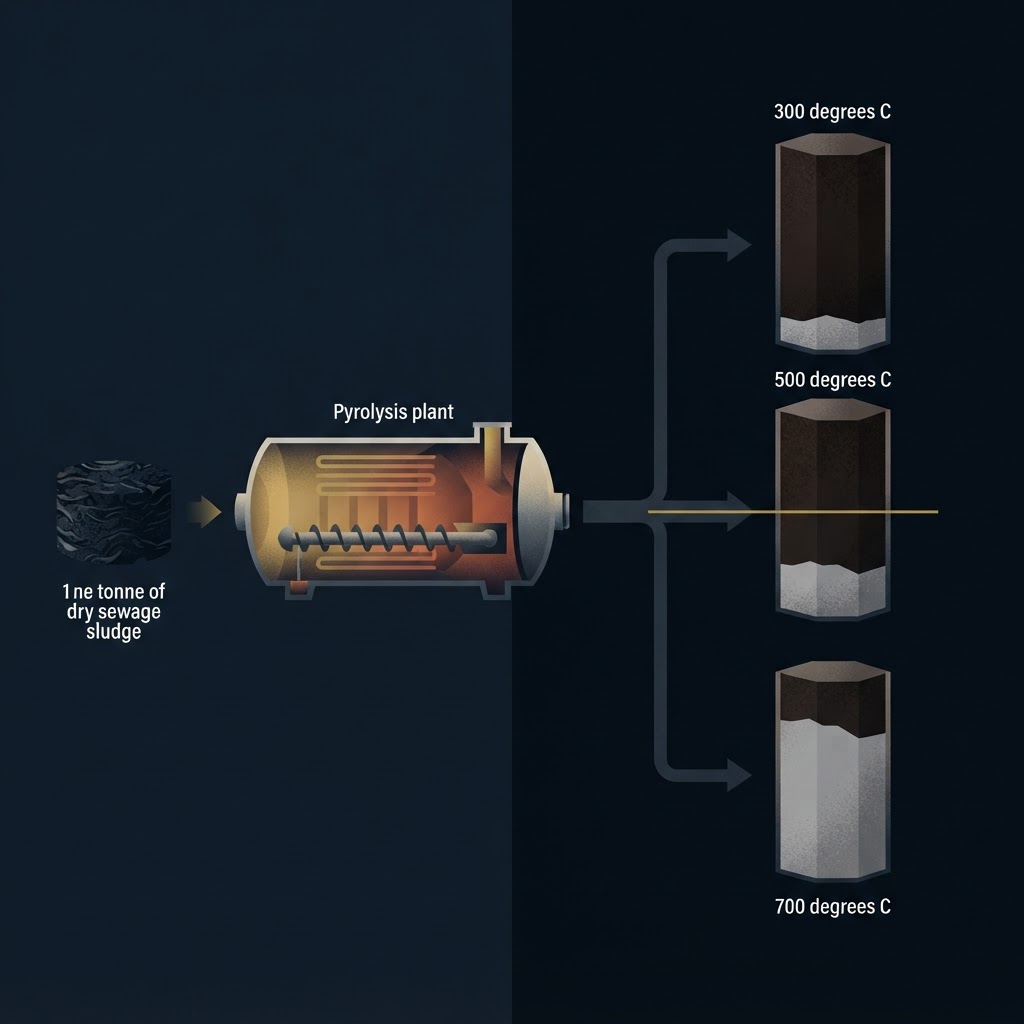
A five-temperature study of municipal sludge measured char yield falling from 74.30 to 51.41 weight percent between 300 and 700 degrees C while ash rose from 38.85 to 82.51 weight percent, and pH climbed from 6.77 in the raw sludge to 10.97 in the 700 degrees C char. Read those two curves together. At 700 degrees C you still recover more than half the dry mass, but four fifths of what you recover is ash. You are not making a carbon product. You are making an alkaline mineral solid with some carbon in it.
Digested sludge yields more char, and less of it is carbon
The single most useful distinction in the literature is one most reviews bury: whether the sludge went through anaerobic digestion first. A 2025 slow-pyrolysis study separated the two streams and found digested sludge yielding 61, 52 and 47 weight percent char at 500, 700 and 900 degrees C against 41, 34 and 31 weight percent for undigested sludge. Digestion already ate the volatile carbon, so what enters the reactor is lower in carbon and higher in mineral to begin with. More char out, less carbon in it, more phosphorus per tonne. If your plant digests, expect the high-yield, high-ash end of every range on this page.
Every 100 degrees costs you mass
Between 300 and 700 degrees C you give up roughly 23 percentage points of yield. That is the price of everything the higher temperature buys you, and the next section is about what it buys. Before you optimise, apply the dry-mass correction: dewatered sludge is only around a fifth solids, so a nominal 55 percent char yield on dry mass is closer to 11 percent of what actually arrives at your gate by truck.
Temperature is one dial and it moves three things at once
There is no optimum setpoint for sludge pyrolysis. There is only a defensible one, because the same dial moves yield, metal chemistry and carbon stability in different directions.
Phosphorus stays put
This is the one unambiguously good result. Experiment plus thermodynamic equilibrium calculation shows over 90 percent of the phosphorus retained in the char up to 850 degrees C, with Pb, Zn and Cd significantly removed over the same range. Phosphorus is effectively non-volatile in this window. Whatever came in with the sludge is still in the solid, concentrated by everything that left as gas.
Heavy metals concentrate, then some of them leave
Concentration is the default. In the five-temperature dataset above, zinc went from 1,341.73 mg/kg in the raw sludge to 2,235.49 mg/kg in the 500 degrees C char, with residual rates of 90.21 percent for Zn, 95.02 for Cu, 92.97 for Cr and 97.57 for Ni. Cadmium and lead behave differently at the top of the range: their residual rates drop to 79.27 and 86.48 percent at 700 degrees C as carbonates decompose and part of the metal volatilises.
The more important finding in that work is speciation, not total mass. BCR sequential extraction shows the bioavailable fractions shifting into residual, mineral-bound form as temperature rises, with measured ecological toxicity falling roughly fourfold around 600 degrees C. Same metal inventory, much less of it mobile. That distinction matters to a risk assessor and not at all to a total-metals limit value, which is a problem if the standard you will be judged by only reads totals.
Carbon stability improves
The carbon that survives gets harder to degrade. The digested-versus-undigested study reports H/C ratios at or below 0.2, indicating strong resistance to biological degradation. That is the property a carbon sink claim rests on, and it improves with temperature at the same time as yield falls.
Put the three together and around 600 degrees C is where the published trade-off is least bad: metals have moved into stable forms, phosphorus is fully retained, cadmium and lead have not yet started volatilising, and yield has not collapsed. Not an optimum. A defensible setpoint you can show a regulator.
The phosphorus is in there. Plant availability is the hard part
Retention is not availability, and this is where the SERP goes quiet.
Most wastewater plants precipitate phosphorus with iron or aluminium salts. Pyrolyse that sludge and the phosphorus stays, but it stays as iron and aluminium phosphates, which are close to useless to a plant root. You have concentrated a nutrient into a form nothing can eat.
The fix is co-pyrolysis, and the mechanism is mineralogical. Blending sludge with a potassium-rich and magnesium-rich biomass converts those phosphates into species that are plant available. Co-pyrolysis of municipal sludge with wheat straw and bakery waste husks forms K2P2O7, CaK2P2O7, KPMgO4 and KZnPO4 instead of Fe and Al phosphates, reaching up to 55 g of P per kg at 900 degrees C in a 90 percent digested sludge blend, while reducing Cd, Pb and Zn but not Cu, Cr or Ni.
Blending pays a second dividend on the metal panel. Reed co-pyrolysis pushes phosphorus the same direction, from non-apatite inorganic P toward apatite P, and dilutes the metals: pure sludge char measured 1,218 to 1,372 mg/kg zinc, above the 1,200 mg/kg grade A threshold in the Chinese agricultural sludge product standard, while the blends fell below it. One decision, two compliance problems moved.
The catch is that co-pyrolysis means sourcing, storing and metering a second feedstock forever. Price that into the operating model before you promise anyone a fertiliser precursor. If phosphorus is the actual objective rather than a by-product, compare this route against the dedicated options in phosphorus recovery from sewage sludge.
Making biochar does not discharge the German obligation
If you are buying a machine because of AbfKlaerV, read this section twice.
The German sewage sludge ordinance makes phosphorus recovery obligatory when the sludge contains 20 grams or more of phosphorus per kilogram of dry solids, with soil-related use closed to plants above 100,000 population equivalents from 2029 and above 50,000 PE from 2032. The ordinance names no technology. That is deliberate, and it is why vendors can all claim compliance.
What the technology choice actually changes is where the duty attaches. The federal environment agency's assessment requires either at least 50 percent P extraction from the sludge total solids, or reduction below 20 g/kg TS, or at least 80 percent recovery from the incineration ash or carbonaceous residue, and it explicitly names sub-stoichiometric processes such as pyrolysis and gasification as accepted thermal pre-treatment. Around 1.8 million tonnes of municipal sewage sludge arise in Germany, all of it eventually inside one of those routes.
So converting sludge to char is a legitimate step. It is not the finish line. Once you have taken the thermal route, the 80 percent recovery duty follows the solid you are now holding, and soil application is closed to exactly the plants the mandate covers. Buy the machine knowing you still owe an answer for the char, and get that answer in writing before commissioning, not after.
What you are allowed to sell it as
The certification position changed recently and in a narrower way than the headlines suggested. EBC version 10.3 admits municipal wastewater biosolids to the positive list as WW-01, but for EBC-BasicMaterials only, with pyrolysis conditions that must exceed 500 degrees C for at least 3 minutes to eliminate micropollutants and polymer additives, and with regular feedstock analysis plus more frequent PCDD/F and heavy metal analysis of the char specified in the operating manual.
BasicMaterials only. The agricultural and feed classes stay closed to biosolids. Every commercial story that makes wood biochar attractive, soil amendment sales, farm distribution, premium carbon removal pricing, runs through classes your sludge char cannot enter. Whether the carbon that does qualify is worth crediting is a certification and MRV question we deliberately leave to specialists in that lane, but plan on the answer being smaller than the brochure.
There is a genuine upside, and it is not agronomic. The 2026 scoping review on sludge biochar finds adsorption and catalysis to be the strongest application areas, driven by surface area, pH and functional group chemistry, with pathogen adsorption still an open research gap. A high-ash, high-surface-area alkaline solid is a good sorbent even when it is a poor fertiliser. Water treatment media, gas cleaning, odour control: those markets do not care about the 50 percent carbon line at all.
Char as a co-product, not a residue
Everything above describes a machine bought to make char, which is a hard business case on this feedstock. There is another way to hold the problem.
The Zero-X X-150 is a 150 kg/h containerized fixed-bed downdraft gasification platform. Its primary product is syngas, and the carbonaceous solid is a co-product. That changes the economics completely, because the char no longer has to carry the capital cost by itself. Gate fees, power and heat do that, and whatever the char earns is upside rather than the business case. The equipment ladder for the char-first alternative is set out in biochar production equipment, and the numbers behind the two models in whether biochar production is profitable.
We write about this feedstock with measured numbers because we run it. Under the COMETHA project in Paris the X-150 completed a 1,939-hour continuous campaign over 80 consecutive days, processing 16,382 kg of digestate pellets and producing syngas at 33 percent hydrogen with 99.98 percent tar conversion and an H2 to CO ratio of 1.95 to 1 in oxy-steam mode. The platform is independently validated at Paris COMETHA, at Verkoso with Fraunhofer IKTS and at Hochschule Zittau/Goerlitz, on high-ash sludge, municipal solid waste and digestate, which are the feedstocks that clinker or foul clean-wood systems. Digestate pellets are the same high-ash, low-volatile material this article has been describing, which is why the yield and ash ranges above are not a surprise to us.
Five questions to ask before you sign
The vendor checklist for the gasifier itself lives with the machine article. These five are about the char, and every one of them should be answered on your sludge, not on a reference case.
- What is the measured carbon content of the char from my feedstock? Above or below 50 percent decides whether you own biochar or a Bio-Carbon-Mineral.
- How much phosphorus is retained, and in which mineral phase? Retention will be high. Ask for the phase, because Fe and Al phosphates are not a fertiliser precursor.
- What does the full heavy metal panel look like against the standard I will be judged by? Totals and speciation, since some regimes read only the first.
- Which EBC class does this char qualify for, if any? Get the pyrolysis residence time and temperature evidence for WW-01 in the same document.
- If it qualifies for none, who takes the residue, at what price, under what contract? A char with no offtake is a storage problem with a certificate.
FAQ
How much biochar do you get from a tonne of sewage sludge?
Between roughly 30 and 60 percent of the dry mass, depending on temperature and on whether the sludge was digested. Digested sludge gave 61 weight percent at 500 degrees C and 47 at 900; undigested gave 41 and 31. The catch is the word dry: dewatered sludge is only about a fifth solids, so the yield on wet tonnage delivered is far lower.
Is sewage sludge biochar safe to put on farmland?
In Germany, for the plants covered by the mandate, it is not a live option regardless of quality, because soil-related use closes for them in 2029 and 2032. Elsewhere it depends on the metal panel. Pyrolysis concentrates Zn, Cu, Cr and Ni even while converting them to less bioavailable forms, and pure sludge char has been measured above grade A product thresholds for zinc.
Can sewage sludge biochar be EBC certified?
Yes, but only as EBC-BasicMaterials under version 10.3, with pyrolysis above 500 degrees C for at least 3 minutes and specified heavy metal and dioxin analysis. The agricultural and feed classes remain closed to biosolids, so the premium soil-amendment market is not available to this product.
What temperature is best for sewage sludge biochar?
There is no single best. Around 600 degrees C is where the published trade-off is least bad: heavy metals shift into stable residual forms and measured ecological toxicity falls about fourfold, phosphorus is still fully retained, and yield has not collapsed. Above 700 degrees C you lose char mass and cadmium and lead begin to volatilise.
Is biochar from sewage sludge the same as biochar from gasification?
No. The solid from a gasifier is a carbonaceous residue, normally lower in carbon and higher in ash than a slow-pyrolysis char, because more of the carbon has been converted to gas. German waste law treats both as thermal pre-treatment, but the EBC carbon threshold applies to the product, so a gasifier char is more likely to land in the Bio-Carbon-Minerals category.
We use cookies to improve your experience on this site. By continuing, you agree to our Privacy Notice.