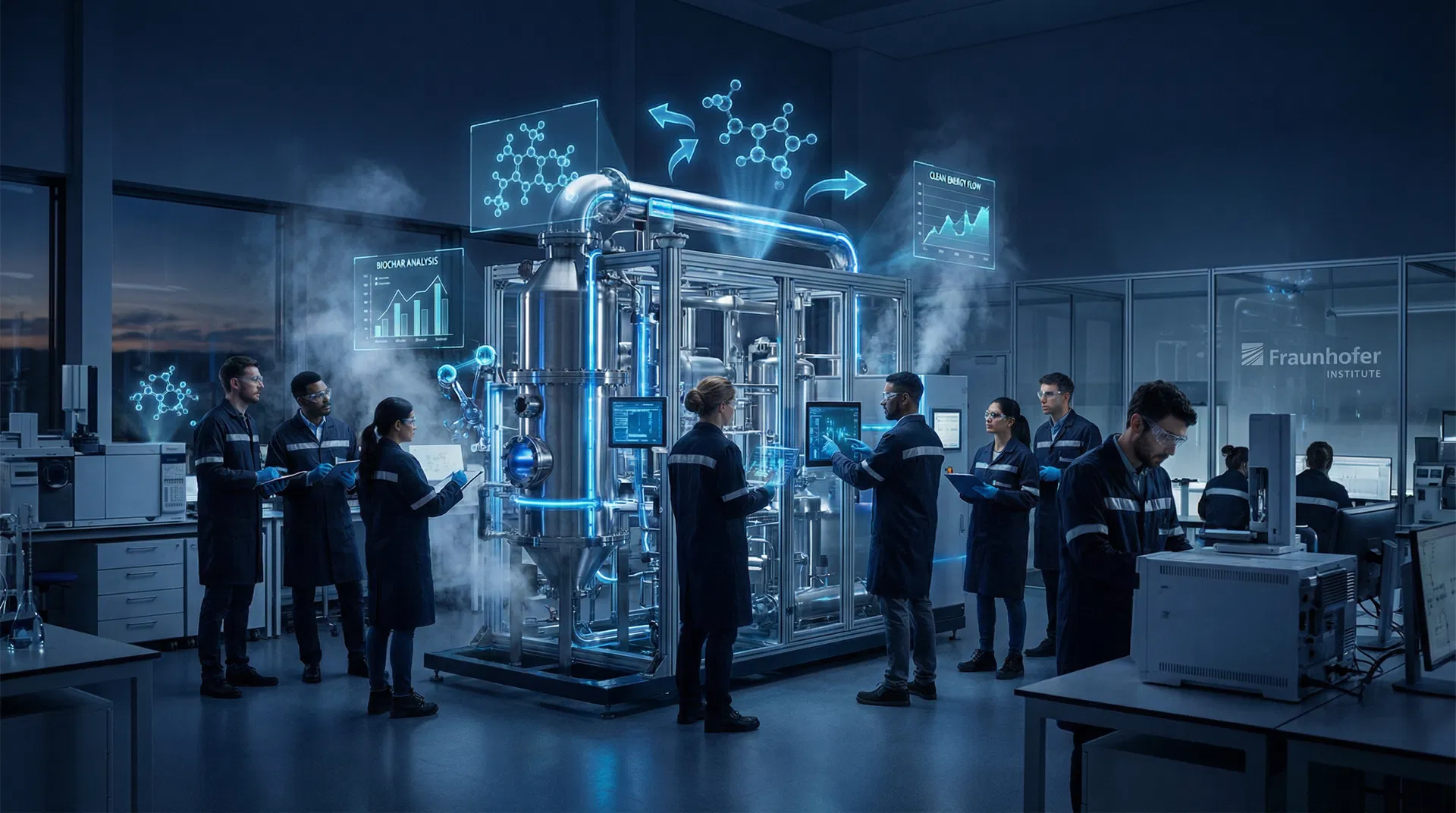
Where Industrial Scale Meets Scientific Rigor
The X-150 is not just a product — it is a living, heavily instrumented research platform with 3,000+ hours of empirical data. We invite visionary academic partners to push the boundaries of thermochemical science alongside us.
What Makes the X-150 a World-Class Research Platform
Four breakthrough capabilities that open entirely new frontiers for academic investigation.
Robust Gasification of Complex Feedstocks
Our active mechanical poker system and water-cooled finger grate inside the reactor core (operating above 1,300°C oxidation zone) enables stable gasification of highly problematic feedstocks containing up to 35% ash content.
Unparalleled testbed for studying thermodynamic behavior and phase transitions of complex ash (agricultural straw, digestate pellets, MSW) under extreme process states.
High-Efficiency Catalytic Tar Reforming
Our CATATOR reformer employs a multi-layer structured metallic mesh loaded with a Ni-Ca/γ-Al₂O₃ catalyst. Operating at 850°C, it achieves a proven 99.98% tar conversion efficiency while tolerating up to 20 ppm H₂S.
Real-world testing environment for Langmuir-Hinshelwood kinetics, catalyst deactivation mechanisms (sintering, coking, sulfur poisoning), and advanced materials science.
AI-Assisted Process Modeling
We utilize neural network algorithms and COMSOL Multiphysics (k-ε turbulence, Maxwell-Stefan diffusion) to model conversion efficiency dynamically, achieving up to 50% better prediction accuracy than traditional stoichiometry.
Rich environment for applied mathematics and CS departments to develop digital twins, predictive maintenance algorithms, and autonomous ML control logic.
Advanced Biochar Characterization
Our biochar exhibits a BET surface area of 170.08 m²/g with 53.25% microporous structure. High carbon content (67.6%), potassium (15.8%), and calcium (3.4%) confirmed by EDX analysis.
Ideal candidate for CCS, methane adsorption, industrial filtration, and agricultural soil amendment research. Hydrophilic nature enables nutrient retention studies.
Five Critical Areas Ripe for Academic Exploration
Based on our extensive COMETHA Phase 2 trials, we have identified the most impactful areas where academic partnership will accelerate the clean energy transition.
Advanced Biochar Applications
CCS, gas filtration, crop yield optimization, and lightweight construction additives based on the stable 170 m²/g surface area.
Ash & Slag Chemistry
Elemental transformations (C/H/N/S/Cl) and mineralogical phase changes of high-silica and high-alkali feedstocks.
Next-Generation Catalysts
Validating novel, lower-cost, or higher-resilience catalyst formulations under empirical, industrial-scale conditions.
Process Integration & Synthesis
Optimizing Water-Gas Shift and Methanation thermodynamics to maximize net Carbon Conversion Efficiency (currently 78–81%).
Carbon Capture & Utilization
Leveraging the system's high-purity CO₂ streams for chemical synthesis or long-term sequestration.
What We Offer Academic Partners
The X-150 platform was developed in deep collaboration with Hochschule Zittau/Görlitz (HSZG) and Fraunhofer IKTS, bridging the gap between theoretical laboratory work and a fully functional 150 kg/h industrial prototype.
Exhaustive Empirical Datasets
3,000+ hours of test run data, P&ID structures, mass/energy Sankey balances — all available for collaborative research.
Joint Grant Applications
Opportunities for joint EU Horizon, national, and regional grant applications, subsidized research projects, and PhD/post-doc fieldwork.
Physical Instrumented Testbed
A fully operational, heavily instrumented industrial prototype for validating theoretical models under real-world conditions.
Established Research Network
Direct connections to Fraunhofer IKTS, TU Zittau/Görlitz, University of York, DLR, and UTP — a proven consortium framework.
Our Existing Research Network
We have already established deep collaborative relationships with leading European research institutions. Join a proven consortium.
SOFC & Ceramics Research
Process Engineering & Thermodynamics
Environmental Science & CCU
Aerospace & Energy Systems
Technology & Process Validation
Audit & Compliance Framework
EU-Funded COMETHA Project
Our COMETHA Phase 2 trials in Paris validated the X-150 with 2,500+ operating hours across multiple waste feedstocks, producing the most comprehensive thermochemical gasification dataset in Europe.