Meeting the Limit Is Not the Same as Being Able to Afford It
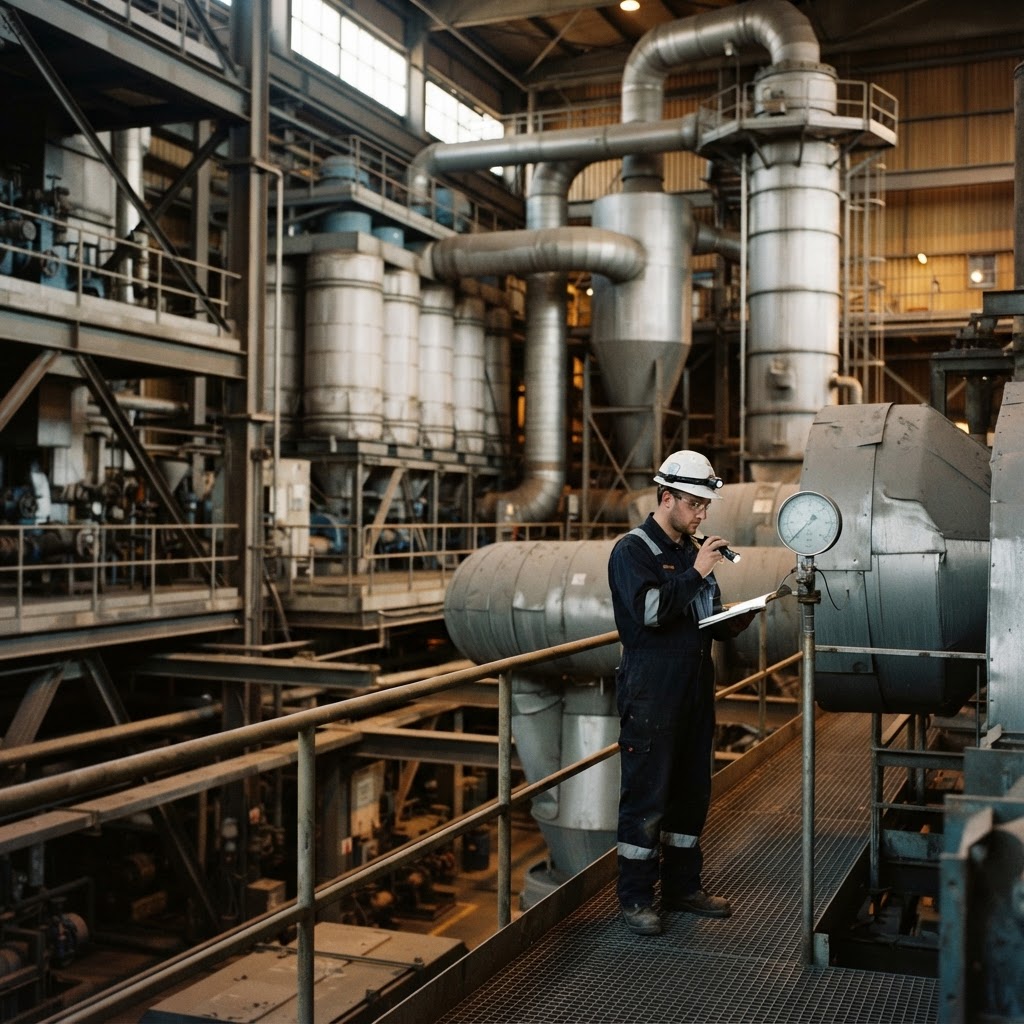
A gas cleaning train is specified against a limit and a guarantee, and both can be met by a plant that spends its margin getting there. What the cleaning stages consume is not recorded in an emissions report. It is subtracted from the output the plant was built to sell.
THE COST THAT DOES NOT APPEAR IN THE COMPLIANCE RECORD
A permit states a concentration. A performance guarantee states that the equipment will achieve it. Neither document states what the plant has to consume, hour after hour, to keep that promise.
This matters because of where the cleaning train sits. It is between the process and the product, and everything it takes in energy, reagents and pressure is taken from the plant's net output. A train can be technically excellent, meet every limit it was given, and still leave the owner with a plant that does not perform as the business case promised. The compliance record will look perfect while the operating account quietly disagrees.
WHERE THE ENERGY GOES
The largest continuous energy cost in most cleaning trains is pressure drop. Every filter, sorbent bed, cyclone, scrubber and length of duct adds resistance, and the fan has to move the entire gas flow through all of it. Fan power rises with the flow and with the pressure it has to overcome, so a train designed with generous margins pays for those margins every hour it runs. It is the easiest cost to read off a meter and one of the easiest to forget when the train is being specified, because at that stage the number is expressed as a pressure and not as an annual bill.
The second energy cost is thermal, and it comes from a structural problem rather than from inefficiency. Cleaning stages work in different temperature windows. A filter that wants to run hot and a scrubber that wants to run cool cannot be placed next to each other without something between them, and that something is usually a heat exchanger, a quench or a reheater. Reheating gas after a wet stage is expensive, and the cheapest way to avoid the cost is to design a sequence that never needs reheating in the first place. That decision is made long before anyone buys a burner, and it is very hard to undo later.
There is a third, quieter energy cost: keeping the train at temperature when the plant is not running at full load. The stages have their own thermal mass, and a train that cools down between shifts has to be brought back up again. This is one of the places where the cleaning design and the plant's operating pattern meet, and where a train that looks efficient on paper can be expensive in a plant that cycles.
WHAT THE REAGENTS COST, AND WHAT THEY LEAVE BEHIND
Sorbents and catalysts are specified by capacity, and capacity is consumed by the contaminants that arrive rather than by the hours the plant runs. This is the number that moves when a feedstock varies. A bed sized against an average will be consumed faster than the average implies, and the replacement interval written into the operating cost quietly shortens.
Around the consumables sits a supply chain that is easy to under-count. Sorbents, alkalis, water and steam all have to be delivered, stored, dosed, and then disposed of. Each of those is a system with its own maintenance load and its own failure modes. A cleaning stage is not one piece of equipment. It is closer to a small chemical plant attached to a gasifier, and it should be costed and maintained as one.
The part that is most often discovered late is the residue. Cleaning does not destroy contaminants. It moves them into something that has to leave the site: filter dust, spent sorbent, catalyst that has lost its activity, condensate from a cooling step, and any liquid effluent from a wet stage. Every one of those streams has to be characterised, classified, stored, transported and either disposed of or sold. That is a project task with a cost and a schedule attached, and it is frequently missed because the people designing the train are focused on the gas. The residue does not exist until the plant runs, and by then the decision has been made.
There is a version of this that goes well. A residue with a use is a product rather than a waste, and a plant that plans for that from the beginning turns a disposal cost into a revenue line. But that is a decision about the whole plant, not about the filter, and it has to be taken early to be worth anything.
WHAT THIS ARGUMENT DOES NOT SOLVE
Cleaning cost cannot be estimated in the abstract, and anyone who offers a number without asking two questions is guessing. Those questions are what is in the feedstock, and what the offtake will accept. Both sit outside the cleaning vendor's control. Specify either one loosely and the cost estimate becomes a range too wide to base a decision on.
Some of the cost is also unavoidable. Cleaning is what makes the gas sellable, and a plant that reduces cleaning to save energy is trading operating cost against product quality or against compliance. That trade has a floor, and the floor is set by the tightest requirement anywhere in the chain rather than by the average of them.
The honest difficulty is measurement. Most plants do not meter their cleaning train as a cost centre. Fan power is metered as plant power, reagents are bought in bulk and held as stock, and residue is handled by a contractor. Without that separation the operator cannot tell whether the train is performing as designed or slowly drifting away from it, and the vendor never receives the operating data that would improve the next design. The argument that cleaning cost matters is easy to make and difficult to evidence on a plant that is not instrumented for it.
There is also a trap in optimising this too hard. The cheapest cleaning train is the one that needs the least cleaning, which means it belongs to the plant whose upstream process is most tightly controlled. Pushing cost out of the cleaning stages does not remove it. It moves it into the gasifier, where it is harder to see and harder to attribute.
QUESTIONS TO ASK BEFORE YOU BUY A CLEANING TRAIN
What is the total pressure drop at design flow, and what does that cost in fan power over a year? Ask for the annual figure rather than the specification, because the specification is the one nobody converts.
Which stages need heating or cooling in order to sit next to each other, and what supplies that heat? Then ask what happens to the answer at minimum load.
What is the consumable consumption per tonne of feedstock, and how does that number change when the feedstock moves off its design basis?
What residues leave the train, in what quantity, and who has costed their classification, handling and disposal? If the answer is nobody yet, that is the answer.
Is the train metered as its own cost centre, so that an operator can watch it drift rather than discover it at the annual review?
And the question that settles most of the rest: what is the tightest requirement the gas has to meet, and is it set by the offtake, by the permit, or by an assumption that nobody has re-checked since the project started?
Talk to us at zero-x.co
We use cookies to improve your experience on this site. By continuing, you agree to our Privacy Notice.